Climate Change Research ›› 2024, Vol. 20 ›› Issue (5): 571-580.doi: 10.12006/j.issn.1673-1719.2024.131
• Impacts of Climate Change • Previous Articles Next Articles
Trends of precipitation and characteristics of wetness-dryness encountering in the water source and receiving areas of the west route of the South-to-North Water Transfer Project
WANG Rong1( ), DU Xiao-Zhong2, CHAO Qing-Chen1, ZHAO Shan-Shan1,3(), YE Dian-Xiu1, LI Xiu-Cang1, LI Ying1,3, ZHANG Meng-Ran2
- 1 National Climate Centre, China Meteorological Administration, Beijing 100081, China
2 China South-to-North Water Transfer Group Co., LTD, Beijing 100036, China
3 China Meteorological Administration Hydro-Meteorology Key Laboratory, Beijing 100081, China
-
Received:2024-06-11Revised:2024-07-18Online:2024-09-30Published:2024-08-28

Cite this article
WANG Rong, DU Xiao-Zhong, CHAO Qing-Chen, ZHAO Shan-Shan, YE Dian-Xiu, LI Xiu-Cang, LI Ying, ZHANG Meng-Ran. Trends of precipitation and characteristics of wetness-dryness encountering in the water source and receiving areas of the west route of the South-to-North Water Transfer Project[J]. Climate Change Research, 2024, 20(5): 571-580.
share this article
Add to citation manager EndNote|Ris|BibTeX
URL: https://www.climatechange.cn/EN/10.12006/j.issn.1673-1719.2024.131
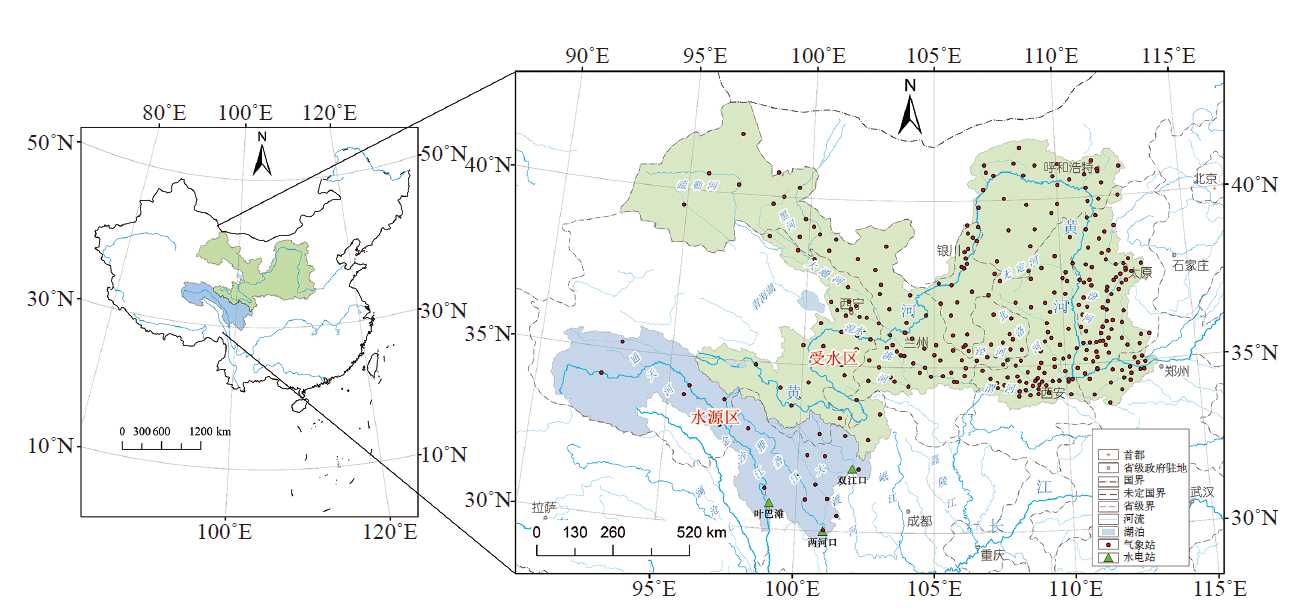
Fig. 1 Distribution of water source area, water receiving area, and national meteorological observation stations in the west route of the South-to-North Water Transfer Project
 |
Table 1 Standards of wetness, normal, and dryness
| |
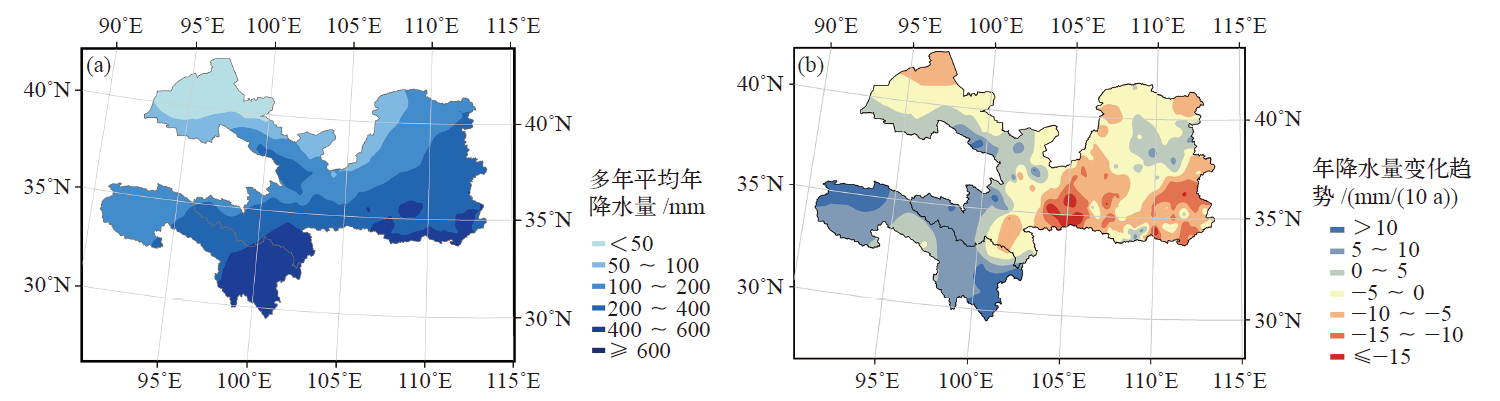
Fig. 2 Spatial distributions of long-term mean precipitation (a) and trend of precipitation (b) of the west route of the South-to-North Water Transfer Project during 1961-2022
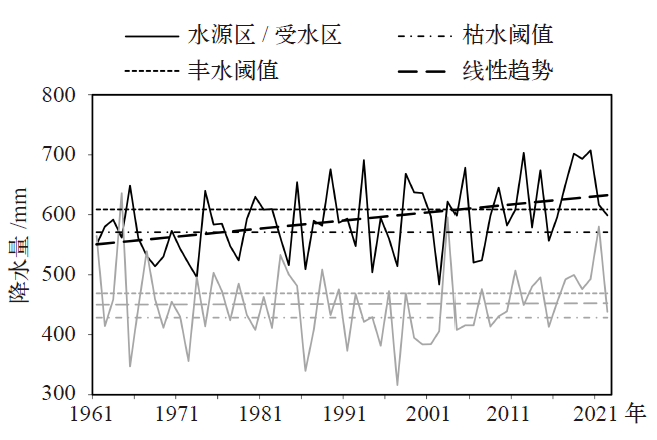
Fig. 3 Annual variations of precipitation in the west route of the South-to-North Water Transfer Project during 1961-2022
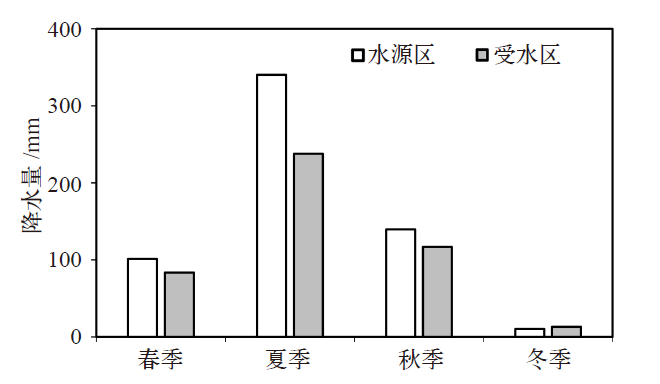
Fig. 4 Seasonal precipitation of the west route of the South-to-North Water Transfer Project during 1961-2022
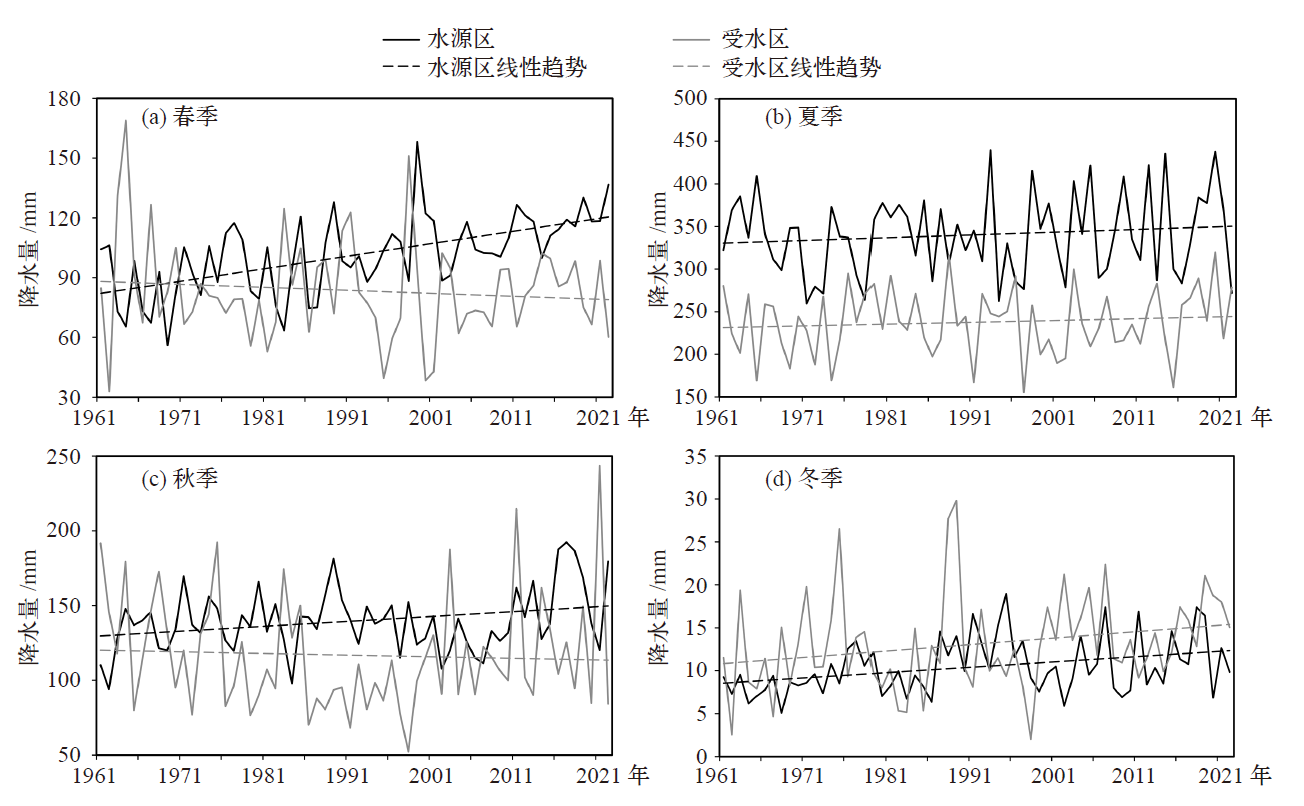
Fig. 5 Annual variation of seasonal precipitation in the west route of the South-to-North Water Transfer Project in the four seasons during 1961-2022

Fig. 6 Spatial distribution of trends of seasonal precipitation in the west route of the South-to-North Water Transfer Project in the four seasons during 1961-2022
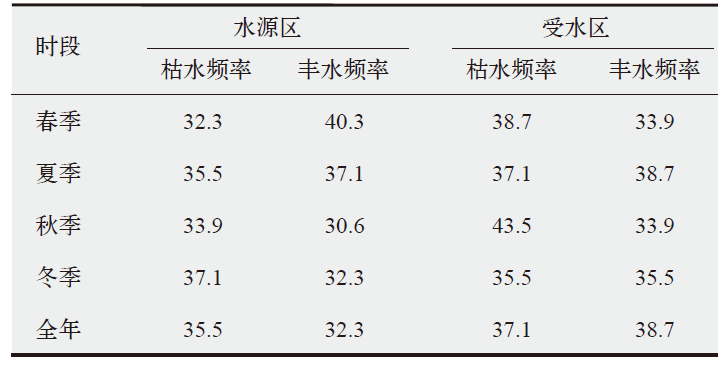 |
Table 2 Seasonal and annual wetness and dryness frequency of the water source area and water receiving area of the west route of the South-to-North Water Transfer Project during 1961-2022 %
| |
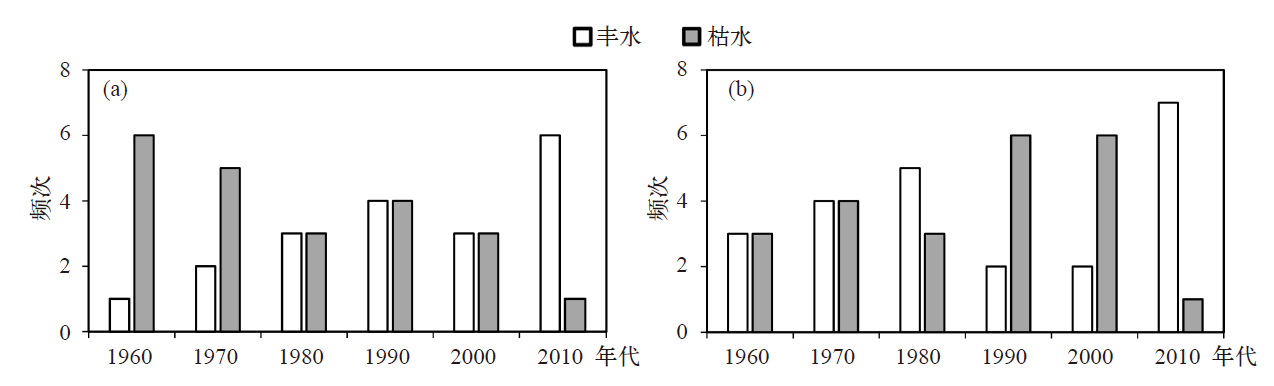
Fig. 7 Decadal frequency of dryness and wetness of the water source area (a) and water receiving area (b) in the west route of the South-to-North Water Transfer Project
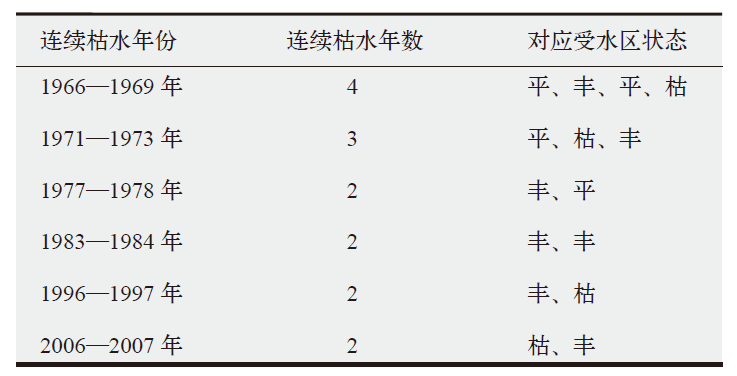 |
Table 3 Continuous dry years in the water source area and the corresponding conditions in the water receiving area of the west route of the South-North Water Transfer Project during 1961-2022
| |
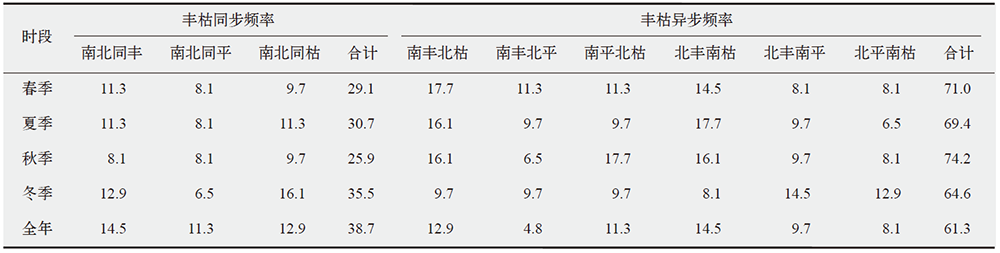 |
Table 4 Seasonal and annual synchrony and asynchrony frequency of precipitation in the water source and receiving areas of the west route of the South-to-North Water Transfer Project during 1961-2022 %
| |
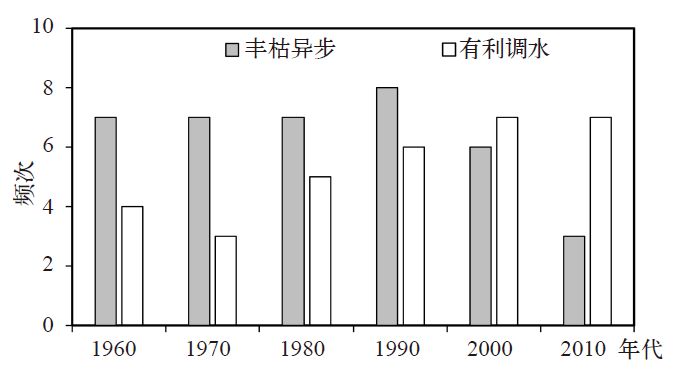
Fig. 8 Decadal frequency of asynchronous precipitation and favorable water transfer conditions in the west route of South-to-North Water Transfer Project
| [1] | Liu J, Zheng C, Zheng L, et al. Ground water sustainability: methodology and application to the North China plain[J]. Ground Water, 2008, 46 (6): 897-909. DOI: 10.1111/J.1745-6548.2008.00486.X |
| [2] | Ye A Z, Duan Q Y, Wu W, et al. The impact of the South-North Water Transfer Project (CTP)’s central route on groundwater table in the Hai River basin, North China[J]. Hydrological Processes, 2014, 28: 5755-5768. DOI: 10.1002/hyp.10081 |
| [3] | 文莉娟, 吕世华, 韦志刚, 等. 南水北调西线引水区与黄河上游降水过程的水汽特征分析[J]. 冰川冻土, 2006, 28 (2): 157-163. |
| Wen L J, Lyu S H, Wei Z G, et al. Water vapor characteristics of precipitation in the west route of the South-to-North Water Diversion Project and the upper reaches of the Yellow River[J]. Journal of Glaciology and Geocryology, 2006, 28 (2): 157-163 (in Chinese) | |
| [4] | 李福生, 彭少明, 李克飞, 等. 南水北调西线工程受水区缺水形势研究[J]. 人民黄河, 2023, 45 (5): 19-23. |
| Li F S, Peng S M, Li K F, et al. Study on water shortage situation in receiving area of west route of South-to-North Water Diversion Project[J]. Yellow River, 2023, 45 (5): 19-23 (in Chinese) | |
| [5] | 文莉娟, 吕世华, 韦志刚, 等. 南水北调西线工程区降水特征分析[J]. 冰川冻土, 2007, 29 (5): 813-818. |
| Wen L J, Lyu S H, Wei Z G, et al. The precipitation characteristics in the South to North Water Transfer area of West China[J]. Journal of Glaciology and Geocryology, 2007, 29 (5): 813-818 (in Chinese) | |
| [6] | 俞煊, 张明珠, 严登华, 等. 南水北调西线工程水源区降水时空特征[J]. 长江流域资源与环境, 2008, 17 (1): 41-45. |
| Yu X, Zhang M Z, Yan D H, et al. On the spatial and temporal distribution of precipitation in the west route of South-to-North Water Transfer Project[J]. Resources and Environment in the Yangtze Basin, 2008, 17 (1): 41-45 (in Chinese) | |
| [7] | 李振朝, 韦志刚, 吕世华, 等. 南水北调西线一期工程引水区和黄河上游区域气候特征分析[J]. 冰川冻土, 2006, 28 (2): 149-156. |
| Li Z C, Wei Z G, Lyu S H, et al. Analysis of climatic characteristics in the water diversion area of the western route Project of South-North Water Diversion and the upstream area of Yellow River[J]. Journal of Glaciology and Geocryology, 2006, 28 (2): 149-156 (in Chinese) | |
| [8] |
郑红星, 刘昌明. 南水北调中线不同水文区降水丰枯遭遇性分析[J]. 地理学报, 2000, 55 (5): 523-532.
doi: 10.11821/xb200005002 |
| Zheng H X, Liu C M. Analysis on asynchronism-synchronism of regional precipitation in planned South-to-North Water Transfer Area[J]. Acta Geographica Sinica, 2000, 55 (5): 523-532 (in Chinese) | |
| [9] | Yan B W, Lu C. Coincidence probability of precipitation for the middle route of South-to-North Water Transfer Project in China[J]. Journal of Hydrology, 2013, 499: 19-26. DOI: 10.1016/j.jhydrol.2013.06.040 |
| [10] | 石卫, 雷静, 李书飞, 等. 南水北调中线水源区与海河受水区丰枯遭遇研究[J]. 人民长江, 2019, 50 (6): 82-87. |
| Shi W, Lei J, Li S F, et al. Study on the occurrence of abundance and drought in the water source area and the receiving area of Haihe River in the middle route of South-to-North Water Transfer Project[J]. Yangtze River, 2019, 50 (6): 82-87 (in Chinese) | |
| [11] | 韩宇平, 蒋任飞, 阮本清. 南水北调中线水源区与受水区丰枯遭遇分析[J]. 华北水利水电大学学报(自然科学版), 2007, 28 (1): 8-11. |
| Han Y P, Jiang R F, Ruan B Q. Analysis on wetness dryness encountering of runoff flow between water source region and receiving water region in the middle route of the South-to-North Water Transfer Project[J]. Journal of North China University of Water Resources and Electric Power (Natural Science Edition), 2007, 28 (1): 8-11 (in Chinese) | |
| [12] | 王政祥, 张明波. 南水北调中线水源与受水区降水丰枯遭遇分析[J]. 人民长江, 2008, 39 (17): 103-105. |
| Wang Z X, Zhang M B. Analysis of precipitation abundance and depletion in water source and receiving area of middle route of South-to-North Water Transfer[J]. Yangtze River, 2008, 39 (17): 103-105 (in Chinese) | |
| [13] | 杨晓玉, 王晓云, 张琳. 南水北调西线一期工程水源区径流丰枯遭遇分析[J]. 黑龙江水利科技, 2015, 43 (6): 15-17. |
| Yang X Y, Wang X Y, Zhang L. Analysis of runoff abundance and depletion in water source area of the first phase of the west route of South-to-North Water Transfer Project[J]. Heilongjiang Water Science and Technology, 2015, 43 (6): 15-17 (in Chinese) | |
| [14] | 冯平, 牛军宜, 张永, 等. 南水北调西线工程水源区河流与黄河的丰枯遭遇分析[J]. 水利学报, 2010, 41 (8): 900-907. |
| Feng P, Niu J Y, Zhang Y, et al. Analysis of wetness-dryness encountering probability among water source rivers and the Yellow River in the western route of South-to-North Water Transfer Project[J]. Journal of Hydraulic Engineering, 2010, 41 (8): 900-907 (in Chinese) | |
| [15] | Zhao P, Yang S, Yu R C. Long-term changes in rainfall over eastern China and large-scale atmospheric circulation associated with recent global warming[J]. Journal of Climate, 2010, 23 (6): 1544-1562 |
| [16] | 陈洁, 刘玉洁, 潘韬, 等. 1961—2010年中国降水时空变化特征及对地表干湿状况影响[J]. 自然资源学报, 2019, 3 (11): 2440-2453. |
| Chen J, Liu Y J, Pan T, et al. Temporal and spatial variations of precipitation over China during 1961-2010 and its impact on dry and wet land surface[J]. Journal of Natural Resources, 2019, 3 (11): 2440-2453 (in Chinese) | |
| [17] | 张建云, 陆采荣, 王国庆, 等. 气候变化对水工程的影响及应对措施[J]. 气候变化研究进展, 2015, 11 (5): 301-307. |
| Zhang J Y, Lu C R, Wang G Q, et al. Impacts of and adaptation to climate change for water conservancy projects[J]. Climate Change Research, 2015, 11 (5): 301-307 | |
| [18] | 魏凤英. 现代气候统计诊断与预测技术[M]. 北京: 气象出版社, 2007: 18-19. |
| Wei F Y. Modern climate statistical diagnosis and prediction techniques[M]. Beijing: Meteorological Press, 2007: 18-19 (in Chinese) | |
| [19] |
常军, 王永光, 赵宇, 等. 近50年黄河流域降水量及雨日的气候变化特征[J]. 高原气象, 2014, 33 (1): 43-54.
doi: 10.7522/j.issn.1000-0534.2012.00177 |
| Chang J, Wang Y G, Zhao Y, et al. Climatic changes of precipitation and rain days in the Yellow River basin in recent 50 years[J]. Plateau Meteorology, 2014, 33 (1): 43-54 (in Chinese) | |
| [20] | 张利娜, 王鹏, 范国庆. 2020年汛期黄河流域降水特征及天气成因综述[J]. 人民黄河, 2021, 43 (11): 29-34. |
| Zhang L N, Wang P, Fan G Q. Precipitation characteristics and synoptic causes in the Yellow River basin during the flood season in 2020[J]. Yellow River of the People, 2021, 43 (11): 29-34 (in Chinese) | |
| [21] | 陈峪, 高歌, 任国玉, 等. 中国十大流域近40多年降水量的时空变化特征[J]. 自然资源学报, 2005, 20 (5): 637-643. |
| Chen Y, Gao G, Ren G Y, et al. Spatial and temporal variations of precipitation in ten major river basins in China over the past 40 years[J]. Journal of Natural Resources, 2005, 20 (5): 637-643 (in Chinese) | |
| [22] | 徐东坡, 李金明, 周祖昊, 等. 1956—2018年中国降水特征的时空分布规律研究[J]. 水利水电技术, 2020, 51 (10): 20-27. |
| Xu D P, Li J M, Zhou Z H, et al. Study on spatial and temporal distribution of precipitation characteristics in China from 1956 to 2018[J]. Water Resources and Hydropower Engineering, 2020, 51 (10): 20-27 (in Chinese) | |
| [23] | 张明珠, 秦天玲, 王凌河, 等. 不同CO2浓度下气候要素变化数值模拟: 以南水北调西线水源区为例[J]. 人民长江, 2011, 42 (3): 53-56, 94. |
| Zhang M Z, Qin T L, Wang L H, et al. Numerical simulation of climate change under different CO2 concentrations: a case study of the water source area of the west route of the South-to-North Water Transfer Project[J]. Yangtze River, 2011, 42 (3): 53-56, 94 (in Chinese) |
| [1] | WU Yao, TANG Hong-Yu, WEI Lin-Xiao, HE Hui-Gen. Analysis of hourly precipitation variations in autumn in West China [J]. Climate Change Research, 2024, 20(5): 558-570. |
| [2] | ZHOU Tian-Yi, JIANG Zhi-Hong, LI Wei, SUN Cen-Xiao. A comparative study of future summer precipitation projections in Northwest China under different physical constraint schemes [J]. Climate Change Research, 2024, 20(4): 403-415. |
| [3] | WU Yan-Wen, YAN Hong-Ming, SHI Zheng-Tao, SHU Kang-Ning. Research on the response of heavy precipitation in Kunming to urbanization and thermal environment changes [J]. Climate Change Research, 2023, 19(6): 723-737. |
| [4] | LUAN Lan, ZHAI Pan-Mao. Changes in rainy season precipitation properties over the Qinghai-Tibet Plateau based on multi-source datasets [J]. Climate Change Research, 2023, 19(2): 173-190. |
| [5] | ZHAN Yun-Jian, CHEN Dong-Hui, LIAO Jie, JU Xiao-Hui, ZHAO Yu-Fei, REN Guo-Yu. Construction of a daily precipitation dataset of 60 city stations in China for the period 1901-2019 [J]. Climate Change Research, 2022, 18(6): 670-682. |
| [6] | ZHANG Shi-Yan, HU Yong-Yun, LI Zhi-Bo. Recent changes and future projection of precipitation in Northwest China [J]. Climate Change Research, 2022, 18(6): 683-694. |
| [7] | MIAO Wen-Fei, LIU Shi-Yin, ZHU Yu, DUAN Shi-Mei, HAN Feng-Ze. Spatio-temporal differentiation and altitude dependence of temperature and precipitation in Meili Snow Mountains [J]. Climate Change Research, 2022, 18(3): 328-342. |
| [8] | WANG Xia, WANG Ying, LIN Qi-Gen, LI Ning, ZHANG Xin-Ren, ZHOU Xiao-Ying. Projection of China landslide disasters population risk under climate change [J]. Climate Change Research, 2022, 18(2): 166-176. |
| [9] | ZHANG Xin-Ran, CHEN Hao-Ming. Assessment of warm season precipitation in the eastern slope of the Tibetan Plateau by CMIP6 models [J]. Climate Change Research, 2022, 18(2): 129-141. |
| [10] | LI Ying, ZHAO Shan-Shan. Floods losses and hazards in China from 2001 to 2020 [J]. Climate Change Research, 2022, 18(2): 154-165. |
| [11] | SUN Chen, WANG Fang, ZHOU Yue-Hua, LI Lan. An assessment on extreme precipitation events in Yangtze River basin as simulated by CWRF regional climate model [J]. Climate Change Research, 2022, 18(1): 44-57. |
| [12] | WANG Qian-Zhi, LIU Kai, WANG Ming. Evaluation of extreme precipitation indices performance based on NEX-GDDP downscaling data over China [J]. Climate Change Research, 2022, 18(1): 31-43. |
| [13] | ZHOU Tian-Jun, CHEN Zi-Ming, CHEN Xiao-Long, ZUO Meng, JIANG Jie, HU Shuai. Interpreting IPCC AR6: future global climate based on projection under scenarios and on near-term information [J]. Climate Change Research, 2021, 17(6): 652-663. |
| [14] | HU Yi-Yang, XU Ying, LI Jin-Jian, HAN Zhen-Yu. Evaluation on the performance of CMIP6 global climate models with different horizontal resolution in simulating the precipitation over China [J]. Climate Change Research, 2021, 17(6): 730-743. |
| [15] | CHEN Yan, HUI Pin-Hong, ZHOU Xue-Dong, YANG Jie. Influence of climate change on the volume capture ratio of annual rainfall’s partition [J]. Climate Change Research, 2021, 17(5): 525-536. |
| Viewed | ||||||
|
Full text |
|
|||||
|
Abstract |
|
|||||