Climate Change Research ›› 2025, Vol. 21 ›› Issue (5): 671-683.doi: 10.12006/j.issn.1673-1719.2025.012
• Impacts of Climate Change • Previous Articles Next Articles
The influence of human activities on extreme heat exposure events in eastern China
LUO Hao-Yue1, SUN Ying2( ), ZHANG Yu-Xia2
- 1
Chongqing Meteorological Service Centre Chongqing 401147, China
2State Key Laboratory of Climate System Prediction and Risk Management/China Meteorological Administration Climate Studies Key Laboratory/National Climate Centre ,China Meteorological Administration Beijing 100081, China
-
Received:2025-01-13Revised:2025-04-28Online:2025-09-30Published:2025-09-05

Cite this article
LUO Hao-Yue, SUN Ying, ZHANG Yu-Xia. The influence of human activities on extreme heat exposure events in eastern China[J]. Climate Change Research, 2025, 21(5): 671-683.
share this article
Add to citation manager EndNote|Ris|BibTeX
URL: https://www.climatechange.cn/EN/10.12006/j.issn.1673-1719.2025.012
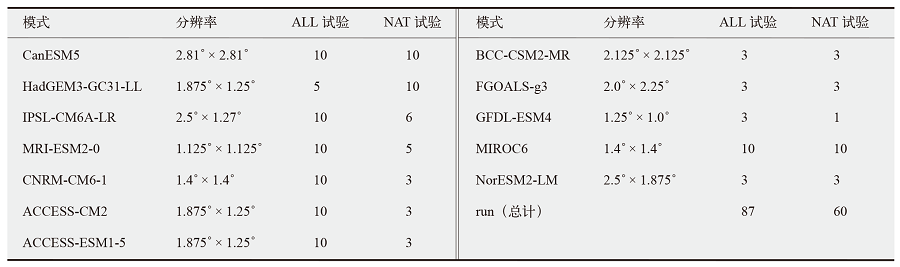 |
Table 1 The CMIP6 models used in this study
| |
 |
Table 2 Extreme heat and heat exposure indicators
| |
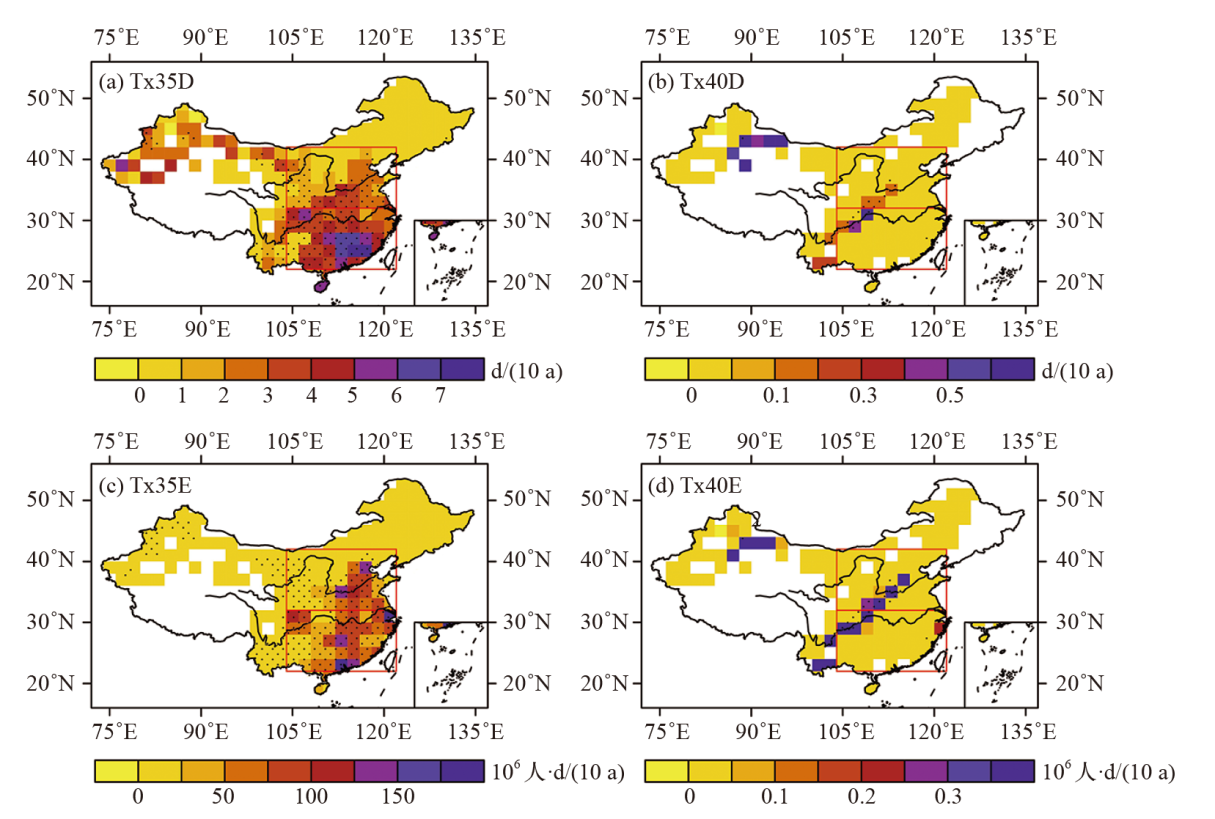
Fig. 1 Spatial distribution of linear trends for Tx35D (a), Tx40D (b), Tx35E (c), and Tx40E (d) in China from May to August during 1990-2022
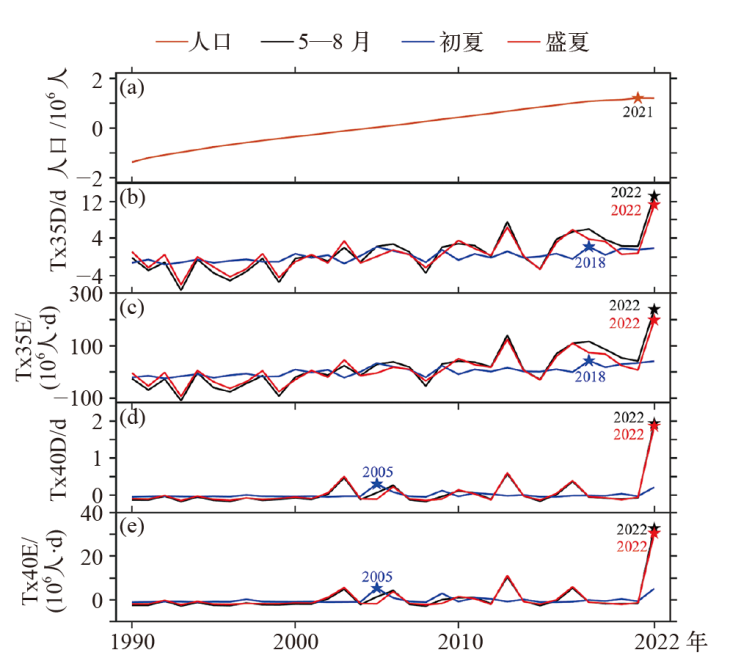
Fig. 2 Changes of population (a), Tx35D (b), Tx35E (c), Tx40D (d), and Tx40E (e) in eastern China from May to August during 1990-2022 (relative to 1995-2014)
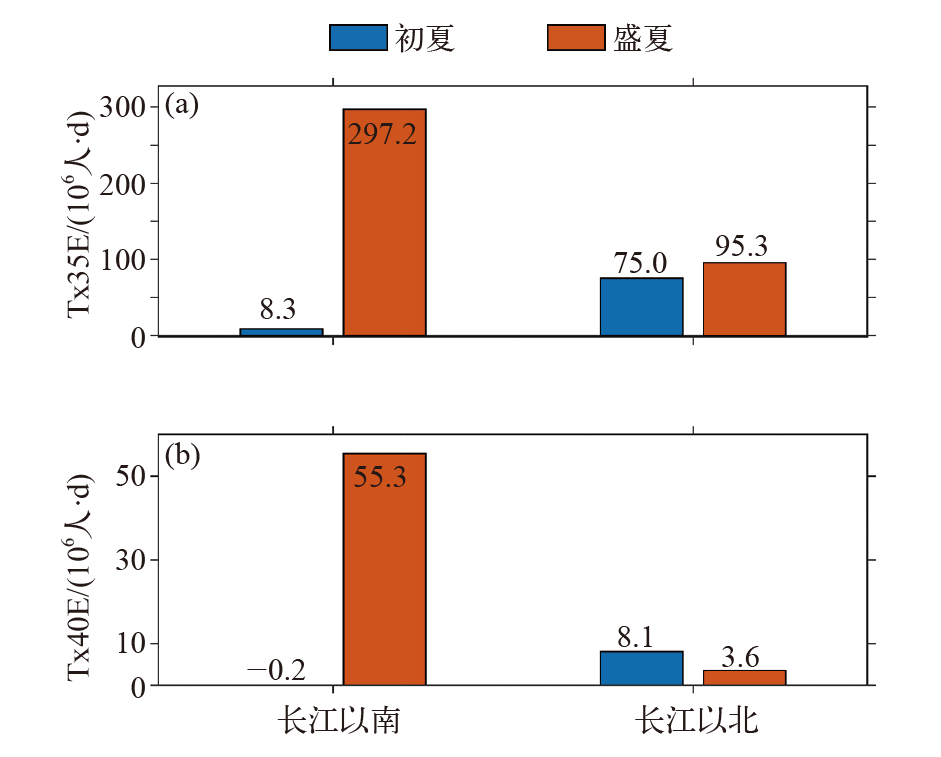
Fig. 3 Observed 2022 anomalies of Tx35E (a) and Tx40E (b) for early summer and summer in the south and north of the Yangtze River (relative to 1995-2014)
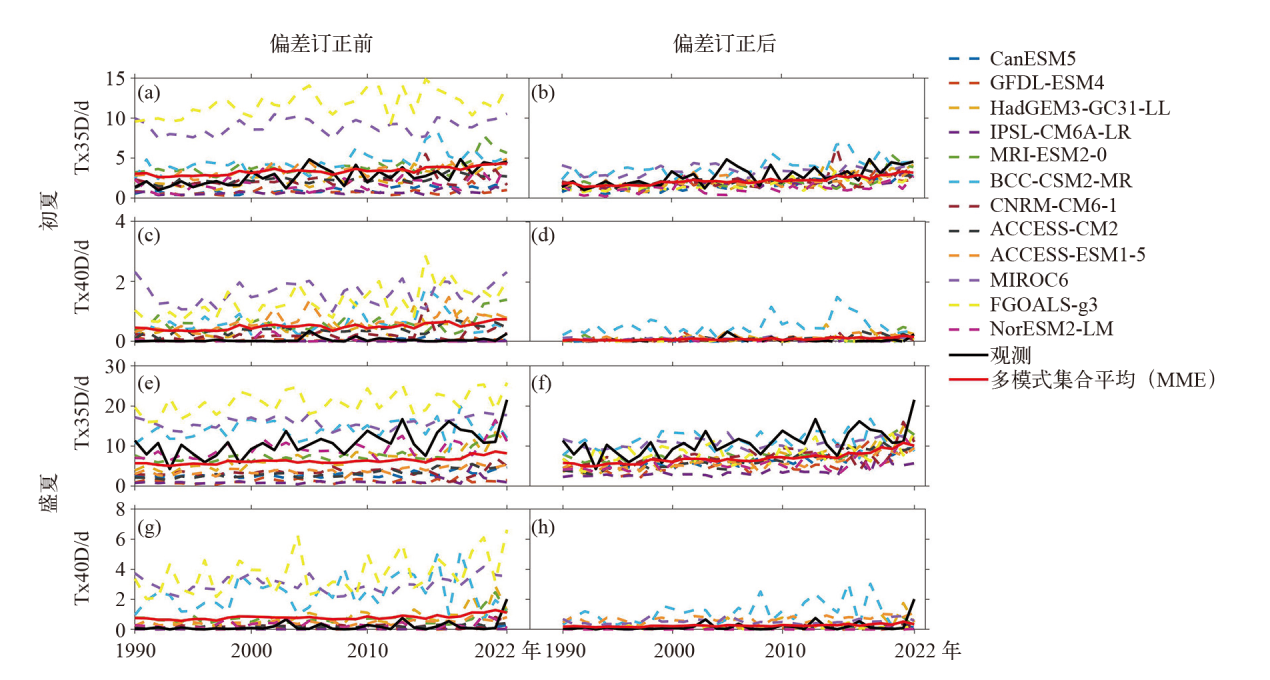
Fig. 4 Original time series of Tx35D (a, b, e, f) and Tx40D (c, d, g, h) for early summer and summer in eastern China from 1990 to 2022, before and after bias correction
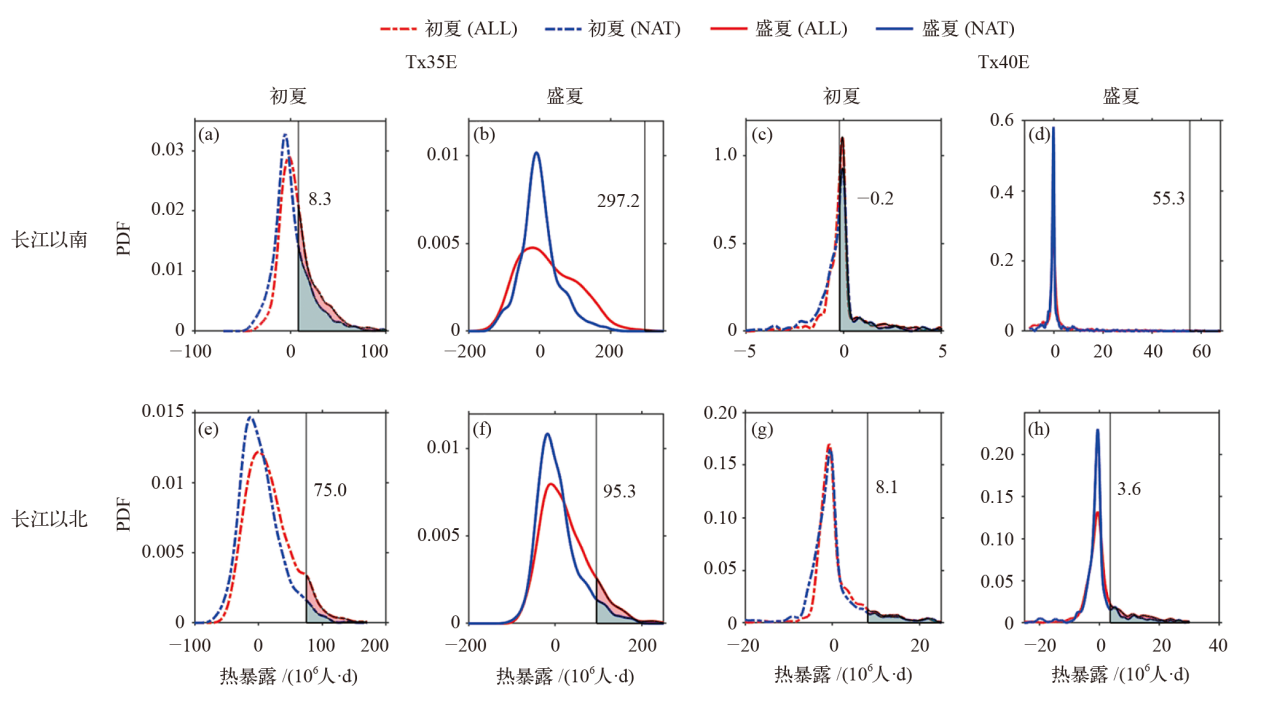
Fig. 5 Probability density distributions of Tx35E (a, b, e, f) and Tx40E (c, d, g, h) for early summer and summer in the south and north of the Yangtze River, under ALL and NAT forcing (relative to 1995-2014)
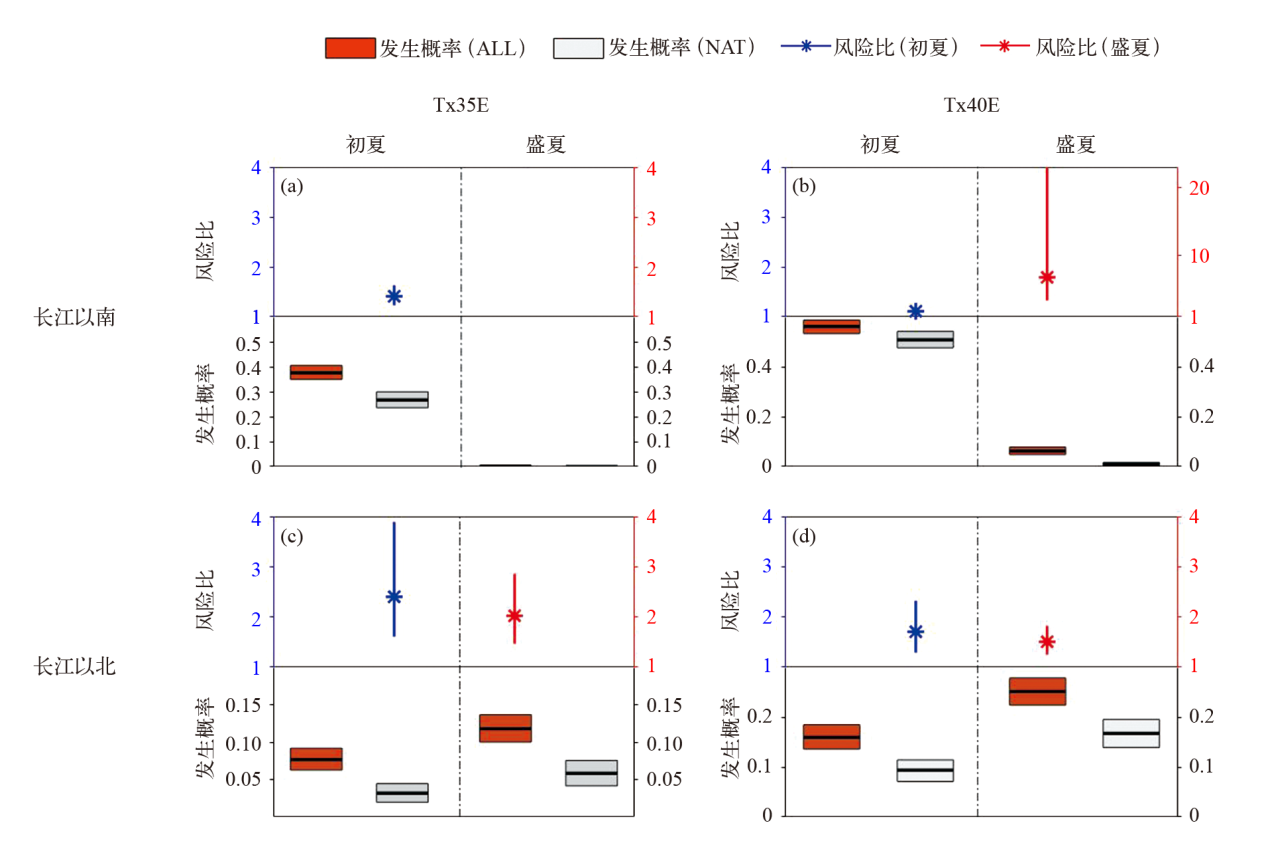
Fig. 6 Risk ratio, probability, and their 95% uncertainty intervals for extreme heat exposure events Tx35E (a, c) and Tx40E (b, d) in early summer and summer of 2022 in the south and north of the Yangtze River
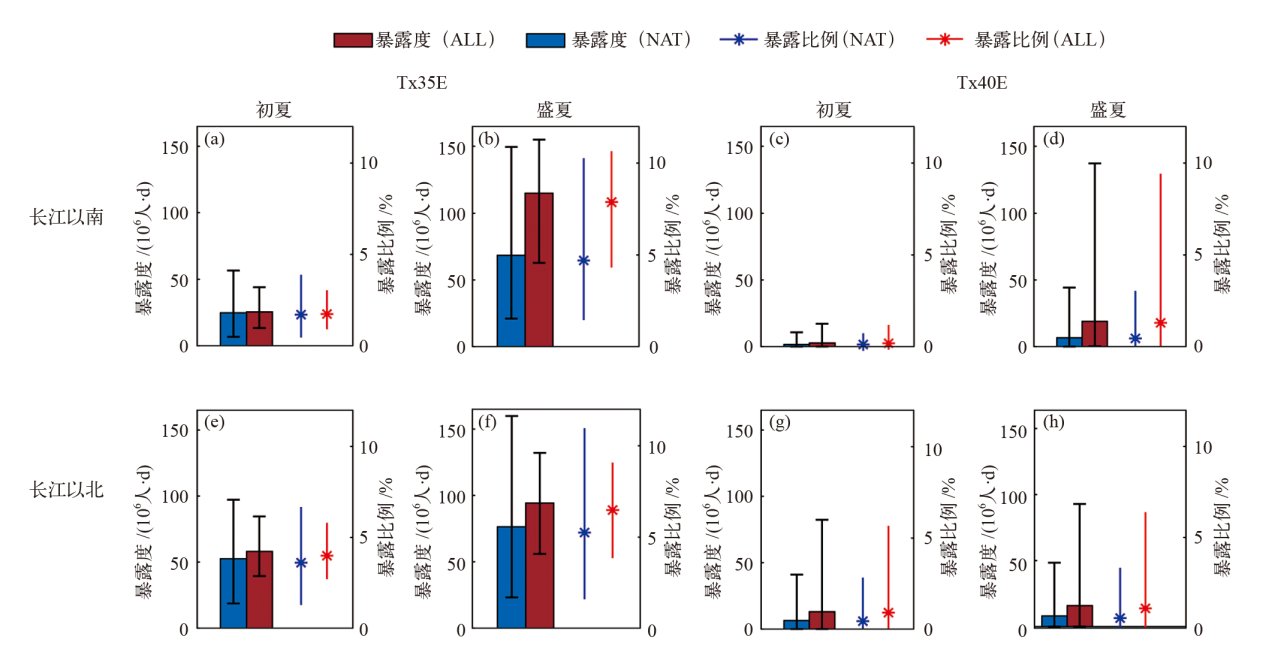
Fig. 7 Heat exposure and exposure ratio under different forcings for Tx35E (a, b, e, f) and Tx40E (c, d, g, h). (CMIP6 multi-model ensemble mean, vertical lines represent the 5%?95% model percentile range)
| [1] | Dunn R J H, Alexander L V, Donat M G, et al. Development of an updated global land in situ-based data set of temperature and precipitation extremes: HadEX3[J]. Journal of Geophysical Research: Atmospheres, 2020, 125: e2019JD032263 |
| [2] | Zhang P F, Ren G Y, Xu Y, et al. Observed changes in extreme temperature over the global land based on a newly developed station daily dataset[J]. Journal of Climate, 2019, 32 (24): 8489-8509 |
| [3] | 尹红, 孙颖. 基于ETCCDI指数2017年中国极端温度和降水特征分析[J]. 气候变化研究进展, 2019, 15 (4): 363-373. |
| Yin H, Sun Y. Characteristics of extreme temperature and precipitation in China in 2017 based on ETCCDI indices[J]. Climate Change Research, 2019, 15 (4): 363-373 (in Chinese) | |
| [4] | Qian C, Zhang X B, Li Z. Linear trends in temperature extremes in China, with an emphasis on non-Gaussian and serially dependent characteristics[J]. Climate Dynamics, 2018, 53 (1-2): 533-550 |
| [5] | IPCC. Climate change: the physical science basis[M]. Cambridge: Cambridge University Press, 2021 |
| [6] | Stott P A, Christidis N, Otto F E L, et al. Attribution of extreme weather and climate-related events[J]. WIREs Climate Change, 2016, 7: 23-41 |
| [7] | Sun Y, Zhang X B, Ding Y H, et al. Understanding human influence on climate change in China[J]. National Science Review, 2021, 9 (3): nwab113 |
| [8] | Peterson T C, Stott P A, Herring S. Explaining extreme events of 2011 from a climate perspective[J]. Bulletin of the American Meteorological Society, 2012, 93 (7): 1041-1067 |
| [9] | Knutson T, Kossin J P, Mears C, et al. Detection and attribution of climate change. In: climate science special report: fourth national climate assessment[R]. USA: U.S. Global Change Research Program, 2017 |
| [10] | Stott P A, Stone D A, Allen M R. Human contribution to the European heatwave of 2003[J]. Nature, 2004, 432: 610-614 |
| [11] | Allen M. Liability for climate change[J]. Nature, 2003, 421 (6926): 891-892 |
| [12] | Peterson T C, Hoerling M P, Stott P A, et al. Explaining extreme events of 2012 from a climate perspective[J]. Bulletin of the American Meteorological Society, 2013, 94 (9): 1-74 |
| [13] | Christidis N, Stott P A, Scaife A A, et al. A new HadGEM3-A-Based system for attribution of weather- and climate-related extreme events[J]. Journal of Climate, 2013, 26 (9): 2756-2783 |
| [14] | Ciavarella A, Christidis N, Andrews M, et al. Upgrade of the HadGEM3-A based attribution system to high resolution and a new validation framework for probabilistic event attribution[J]. Weather and Climate Extremes, 2018: 9-32 |
| [15] | Walters D, Boutle I, Brooks M, et al. The met office unified model global atmosphere 6.0/6.1 and Jules global land 6.0/6.1 configurations[J]. Geoscientific Model Development, 2017, 10 (4): 1487-1520 |
| [16] | Stott P, Christidis N, Otto F, et al. Attribution of extreme weather events in the context of climate change[M]. Washington, DC: the National Academies Press, 2016 |
| [17] | 中国气象局气候变化中心. 中国气候变化蓝皮书(2021)[M]. 北京: 科学出版社, 2021. |
| China Meteorological Administration Climate Change Centre. Blue book on climate change in China (2021)[M]. Beijing: Science Press, 2021 (in Chinese) | |
| [18] | Sun Y, Zhang X B, Zwiers F W, et al. Rapid increase in the risk to extreme summer heat in eastern China[J]. Nature Climate Change, 2014, 4: 1082-1085 |
| [19] | Chen W, Dong B W. Drivers of the severity of the extreme hot summer of 2015 in western China[J]. Journal of Meteorological Research, 2019, 32 (6): 1002-1010 |
| [20] | Lu C H, Sun Y, Christidis N, et al. Contribution of global warming and atmospheric circulation to the hottest spring in eastern China in 2018[J]. Advances in Atmospheric Sciences, 2020, 37 (11): 1285-1294 |
| [21] | Qian C, Ye Y B, Jiang J C, et al. Rapid attribution of the record-breaking heatwave event in North China in June 2023 and future risks[J]. Environmental Research Letters, 2024, 19 (1): 014028 |
| [22] |
Song L C, Dong S Y, Sun Y, et al. Role of anthropogenic forcing in 2014 hot spring in northern China[J]. Bulletin of the American Meteorological Society, 2015, 96 (12): 111-114
doi: 10.1175/BAMS-D-15-00111.1 |
| [23] | Sun Y, Song L C, Yin H, et al. Human influence on the 2015 extreme high temperature events in western China[J]. Bulletin of the American Meteorological Society, 2016, 97 (12): 102-106 |
| [24] | Wang D Q, Sun Y. Effects of anthropogenic forcing and atmospheric circulation on the record-breaking welt bulb heat event over southern China in September 2021[J]. Advances in Climate Change Research, 2022, 13 (6): 778-786 |
| [25] | Jones B, O’neill B C, Mcdaniel L, et al. Future population exposure to US heat extremes[J]. Nature Climate Change, 2015, 5 (7): 652-655 |
| [26] | Xie W X, Zhou B T, Han Z Y, et al. Substantial increase in daytime-nighttime compound heat waves and associated population exposure in China projected by the CMIP6 multimodel ensemble[J]. Environmental Research Letters, 2022, 17 (4): 045007 |
| [27] | He T, Wang N, Tong Y D, et al. Anthropogenic activities change population heat exposure much more than natural factors and land use change: an analysis of 2020-2100 under SSP-RCP scenarios in Chinese cities[J]. Sustainable Cities and Society, 2023, 96: 104699 |
| [28] | Liu Z, Anderson B, Yan K, et al. Global and regional changes in exposure to extreme heat and the relative contributions of climate and population change[J]. Scientific Reports, 2017, 7 (1): 43909 |
| [29] | Zhang G W, Zeng G, Liang X Z, et al. Increasing heat risk in China’s urban agglomerations[J]. Environmental Research Letters, 2021, 16 (6): 064073 |
| [30] | Gao S J, Chen Y H, Chen D L, et al. Urbanization-induced warming amplifies population exposure to compound heatwaves but narrows exposure inequality between global north and south cities[J]. npj Climate and Atmospheric Science, 2024, 7 (1): 154 |
| [31] | Lin H, Yu X, Lin Y M, et al. Spatiotemporal variations of precipitation extremes and population exposure in the Beijing-Tianjin-Hebei region, China[J]. Water, 2024, 16 (24): 3594 |
| [32] | Sikarwar A, Golaz V. Substantial increase in population exposure to multiple environmental burdens in sub-Saharan Africa (2000-2019)[J]. Environmental Research Letters, 2024, 19 (4): 044068 |
| [33] | Mallapaty S. China’s extreme weather challenges scientists trying to study it[J]. Nature, 2022, 609 (7929): 888 |
| [34] | Cao L J, Zhu Y N, Tang G L, et al. Climatic warming in China according to a homogenized data set from 2419 stations[J]. International Journal of Climatology, 2016, 36 (13): 4384-4392 |
| [35] | 徐川, 赵天保, 张京朋, 等. CMIP6模式模拟的人类活动和自然强迫对全球地表气温多尺度变化的影响[J]. 地球物理学报, 2024, 67 (2): 477-491. |
| Xu C, Zhao T B, Zhang J P, et al. Effects of human activities and natural forcings on multiscale changes of global land surface air temperature simulated by CMIP6 models[J]. Chinese Journal of Geophysics, 2024, 67 (2): 477-491 (in Chinese) | |
| [36] | O’neill B C, Tebaldi C, van Vuuren D P, et al. The Scenario Model Intercomparison Project (ScenarioMIP) for CMIP 6 [J]. Geoscientific Model Development, 2016, 9 (9): 3461-3482 |
| [37] | Guo J H, Wang X Q, Fan Y R, et al. How extreme events in China would be affected by global warming: insights from a bias-corrected CMIP6 ensemble[J]. Earth’s Future, 2023, 11 (4): e2022EF003347 |
| [38] | Zhang C W, Wu G C, Zhao R Z, et al. The performance of CMIP6 models in describing the temperature annual cycle in China from 1961 to 2014[J]. Theoretical and Applied Climatology, 2023, 154 (1-2): 705-715 |
| [39] | Zhu H H, Jiang Z H, Li L. Projection of climate extremes in China, an incremental exercise from CMIP5 to CMIP6[J]. Science Bulletin (Beijing), 2021, 66 (24): 2528-2537 |
| [40] |
Liu L L, Cao X, Li S J, et al. A 31-year (1990-2020) global gridded population dataset generated by cluster analysis and statistical learning[J]. Scientific Data, 2024, 11 (1): 124
doi: 10.1038/s41597-024-02913-0 pmid: 38267476 |
| [41] | Sun Y, Hu T, Zhang X B. Substantial increase in heat wave risks in China in a future warmer world[J]. Earth’s Future, 2018, 6 (11): 1528-1538 |
| [42] | Zhang Y X, Sun Y, Hu T. Changes in extreme high temperature warning indicators over China under different global warming levels[J]. Science China: Earth Sciences, 2024, 67 (6): 1895-1909 |
| [43] | Seneviratne S I, Hauser M. Regional climate sensitivity of climate extremes in CMIP6 versus CMIP5 multimodel ensembles[J]. Earths Future, 2020, 8 (9): e2019EF001474 |
| [44] | Tang S K, Qiao S B, Wang B, et al. Linkages of unprecedented 2022 Yangtze River valley heatwaves to Pakistan flood and triple-dip La Niña[J]. npj Climate and Atmospheric Science, 2023, 6 (1): 44 |
| [45] | Hua W J, Dai A G, Qin M H, et al. How unexpected was the 2022 summertime heat extremes in the middle reaches of the Yangtze River?[J]. Geophysical Research Letters, 2023, 50 (16): e2023GL104269 |
| [46] | 史印山, 谷永利, 林艳. 京津冀高温天气的时空分布及环流特征分析[J]. 气象, 2009, 35 (6): 63-69. |
| Shi Y S, Gu Y L, Lin Y. Analysis of the temporal and spatial distribution and circulation features of high temperatures in Beijing, Tianjin and Hebei[J]. Meteorological Monthly, 2009, 35 (6): 63-69 (in Chinese) | |
| [47] | Gong H N, Ma K J, Hu Z Y, et al. Attribution of the August 2022 extreme heatwave in southern China: role of dynamical and thermodynamical processes[J]. Bulletin of the American Meteorological Society, 2024, 105 (1): 193-199 |
| [48] | Xu K, Lu R Y, M J Y, et al. Circulation anomalies in the mid-high latitudes responsible for the extremely hot summer of 2018 over Northeast Asia[J]. Atmospheric and Oceanic Science Letters, 2019, 12 (4): 231-237 |
| [1] | CHEN Si-Da, LIU Kai, LI Bo-Hao, WANG Ming. The analysis of record-breaking probability of extreme weather in China’s poverty-alleviated counties [J]. Climate Change Research, 2025, 21(3): 327-339. |
| [2] | ZHOU Tian-Yi, JIANG Zhi-Hong, LI Wei, SUN Cen-Xiao. A comparative study of future summer precipitation projections in Northwest China under different physical constraint schemes [J]. Climate Change Research, 2024, 20(4): 403-415. |
| [3] | SUN Xiao-Ling, XIE Wen-Xin, ZHOU Bo-Tao. CMIP6 evaluation and projection of terrestrial ecosystem over Asia [J]. Climate Change Research, 2023, 19(1): 49-62. |
| [4] | ZHANG Xin-Ran, CHEN Hao-Ming. Assessment of warm season precipitation in the eastern slope of the Tibetan Plateau by CMIP6 models [J]. Climate Change Research, 2022, 18(2): 129-141. |
| [5] | HUANG Lu-Feng, ZHU Zai-Chun, HUANG Meng-Tian, ZHAO Qian, MA Wei-Rui, ZENG Hui. Projection of gross primary productivity change of global terrestrial ecosystem in the 21st century based on optimal ensemble averaging of CMIP6 models [J]. Climate Change Research, 2021, 17(5): 514-524. |
| [6] | TANG Zi-Chen, LI Qing-Quan, WANG Li-Juan, WU Li-Quan. Preliminary assessment on CMIP6 decadal prediction ability of air temperature over China [J]. Climate Change Research, 2021, 17(2): 162-174. |
| [7] | Duo-Ying JI,Qian ZHANG,Zhi-Cheng LUO,Yang-Xin CHEN. Short commentary on CMIP6 Carbon Dioxide Removal Model Intercomparison Project (CDRMIP) [J]. Climate Change Research, 2019, 15(5): 457-464. |
| [8] | Li-Xia ZHANG,Xiao-Long CHEN,Xiao-Ge XIN. Short commentary on CMIP6 Scenario Model Intercomparison Project (ScenarioMIP) [J]. Climate Change Research, 2019, 15(5): 519-525. |
| [9] | Zhen-Ya SONG,Ying BAO,Fang-Li QIAO. Introduction of FIO-ESM v2.0 and its participation plan in CMIP6 experiments [J]. Climate Change Research, 2019, 15(5): 558-565. |
| [10] | Cheng QIAN,Wen-Xia ZHANG. Short commentary on CMIP6 Detection and Attribution Model Intercomparison Project (DAMIP) [J]. Climate Change Research, 2019, 15(5): 469-475. |
| [11] | Jian CAO,Li-Bin MA,Juan LI,WANG Bin,Bo WANG. Introduction of NUIST-ESM model and its CMIP6 activities [J]. Climate Change Research, 2019, 15(5): 566-570. |
| [12] | Lei WANG,Qing BAO,Bian HE. Short commentary on CMIP6 High Resolution Model Intercomparison Project (HighResMIP) [J]. Climate Change Research, 2019, 15(5): 498-502. |
| [13] | Xiao-Ge XIN,Tong-Wen WU,Jie ZHANG,Fang ZHANG,Wei-Ping LI,Yan-Wu ZHANG,Yi-Xiong LU,Yong-Jie FANG,Wei-Hua JIE,Li ZHANG,Min DONG,Xue-Li SHI,Jiang-Long LI,Min CHU,Qian-Xia LIU,Jing-Hui YAN. Introduction of BCC models and its participation in CMIP6 [J]. Climate Change Research, 2019, 15(5): 533-539. |
| [14] | Yan-Li TANG,Yong-Qiang YU,Li-Juan LI,Li DONG,Jin-Bo XIE,Peng-Fei LIN,Ye PU,Bin WANG,Yan WANG,Bing-Hao JIA,Pei-Hua QIN,Mi-Rong SONG,Zheng-Hui XIE. The introduction of FGOALS-g model and the experiment design in CMIP6 [J]. Climate Change Research, 2019, 15(5): 551-557. |
| [15] | Yan-Luan LIN,Xiao-Meng HUANG,Yi-Shuang LIANG,Yi QIN,Shi-Ming XU,Wen-Yu HUANG,Fang-Hua XU,Li LIU,Yong WANG,Yi-Ran PENG,Lan-Ning WANG,Wei XUE,Hao-Huan FU,Guang-Jun ZHANG,Bin WANG,Rui-Zhe LI,Cheng ZHANG,Hui LU,Kun YANG,Yong LUO,Yu-Qi BAI,Zhen-Ya SONG,Min-Qi WANG,Wen-Jie ZHAO,Feng ZHANG,Jing-Heng XU,Xi ZHAO,Chun-Song LU,Yi-Qi LUO,Yi-Zhao CHEN,Yong HU,Qiang TANG,De-Xun CHEN,Guang-Wen YANG,Peng GONG. The Community Integrated Earth System Model (CIESM) from Tsinghua University and its plan for CMIP6 experiments [J]. Climate Change Research, 2019, 15(5): 545-550. |
| Viewed | ||||||
|
Full text |
|
|||||
|
Abstract |
|
|||||