

引言
适应气候变化能力建设一直是国际社会应对气候变化的核心议题之一,直接关系到各国,特别是发展中国家和最脆弱国家,能否有效应对气候变化带来的多重挑战,也是实现可持续发展和消除贫困的重要路径[1]。《巴黎协定》①(① FCCC/CP/2015/10/Add.1 (
农业是遭受气候变化胁迫最严重的行业之一。全球变暖导致极端气候事件频发、降水模式改变以及病虫害加剧,严重威胁农业生产和粮食安全[2]。《巴黎协定》对农业适应能力的定义为,通过减少气候风险、提高生产力和保障粮食安全等措施提升农业系统应对气候变化的韧性。我国是全球气候变化的敏感区和脆弱区,受生态资源禀赋、产业结构和经济发展水平等多种因素影响,农业适应能力明显不足[3]。本文按照农业气候资源高效利用、农业防灾减灾、生态治理和气候风险管理的逻辑层次回顾农业适应气候变化能力建设的进展,总结限制农业适应能力提升的瓶颈,提出未来提升农业适应能力的建议。本文首先回顾我国农业适应气候变化领域相关文献,梳理农业适应气候变化科学认知的进展,将其按照气候系统对农业系统影响的逻辑层次,总结在气候资源利用、减灾、农业生物多样性保护提升生态系统服务能力建设方面的进展,以及技术创新、资金机制创新和管理能力创新方面对农业适应能力提升的支撑,分析当前适应能力建设方面的不足,提出未来提升农业适应能力的建议。
1 适应科学认知支撑农业适应行动
1.1 科学认知
我国学者对农业适应气候变化的研究始于1982年[4],但在起步阶段进程较缓慢(图1)。1994年我国启动“中国气候变化国别研究”,研究目标为气候变化的影响与脆弱性评价及适应性技术对策;自1995年开始国际期刊上逐渐出现中国学者的文章(图1)。早期的研究探讨中国农业对全球变暖的敏感性和脆弱性,并进行适应成本效益分析,强调综合农业与经济模型的重要性[5-6]。我国学者当时已经意识到适应全球变化的对策可以分为短期的、操作层面的适应性调整,这与当前增量适应(incremental adaptation)的内涵一致,即气候变化导致的环境胁迫不超过受体系统自适应能力与人为适应能力之和时,采取渐进递增的适应对策;以及针对社会经济结构和制度层面的长期性、系统性调整的能力建设,这与转型适应(transformational adaptation)的内涵一致[7],即当气候变化的胁迫超出了系统的自适应能力和经济上可行的调控能力时,采取整体转型的适应方式。
图1
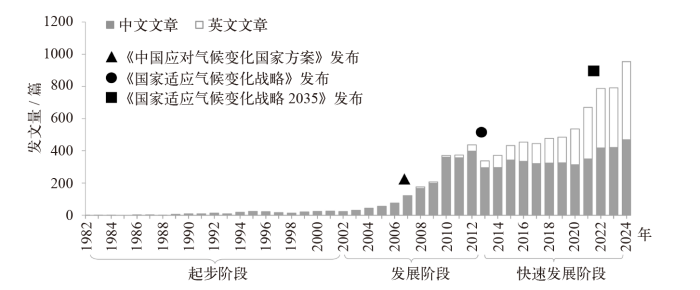
图1
农业适应能力主题文献发表情况概览
注:在知网/Web of Science上分别以“气候变化/climate change”“适应/adaptation”和“农业/agriculture”为主题进行文献检索。检索时间限定为2024年12月以前发表的文献。其中,Web of Science限定研究区域为中国,在知网上共检索到相关文章6425篇,时间跨度为1982—2024年;在Web of Science上检索到英文论文2635篇,时间跨度为1995—2024年。
Fig. 1
Overview of literature published on the topic of adaptive capacity in agriculture
随着科学认识的日趋深入,我国学界对农业适应气候变化的研究逐步推进,这一阶段研究重点关注气候及其变率变化在不同地区对不同作物的影响评估[8-9]、气候变化特征分析[10]、气候资源分析和区划[11],发展与气候模型嵌套的作物模型进行区域作物影响模拟[12-13]、评估气候变化对农业生态的影响[14-15]等。上述研究为深入理解农业适应气候变化奠定了快速发展的基础。随后农业适应气候变化进入快速发展阶段,更多研究关注气候变化背景下我国主要作物农业气象灾害的时空分布特征、极端事件的时空分布特征及对农业的影响,不仅包括气候变化对作物产量及其构成要素的影响,也关注作物品质对气候变化的响应,聚焦“粮食安全-水资源-能源供应”等综合性“关联”(nexus)议题研究,拓展适应研究内涵。
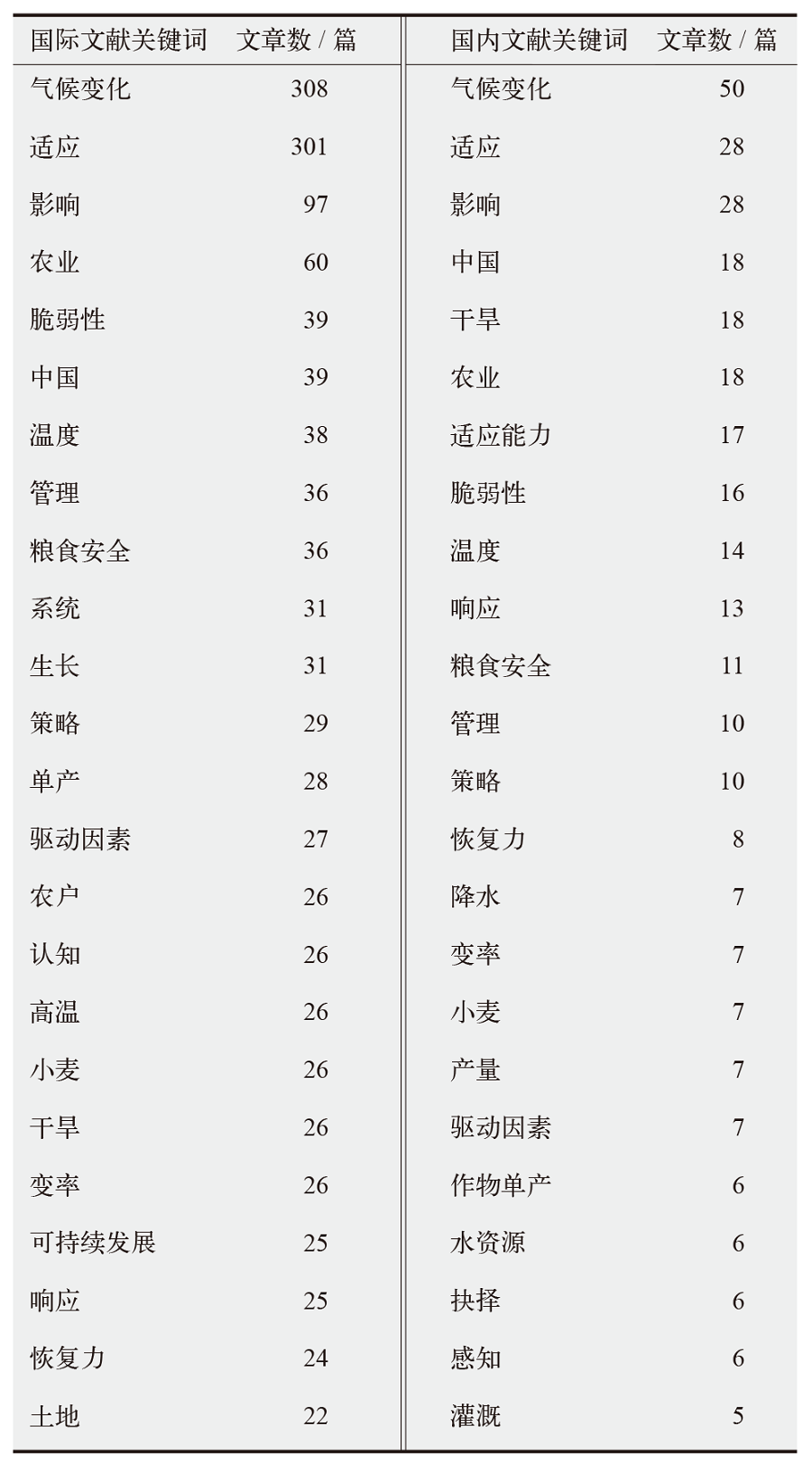
对检索到的农业适应主题文献进行关键词的共现结果分析,如表1所示。结果表明,无论国际还是国内,气候变化、适应和影响都是关注焦点。其中国际上更关注对农业脆弱性的研究,而国内更关注具体的干旱事件对农业的影响,因为我国农业生产的最大气象灾害是干旱。因此,应对干旱一直是中国农业适应的优先议题。尤其是气候变化下,干旱胁迫日益加剧,是目前对中国农业影响最广、范围最大的灾害,不仅影响种植业,对畜牧业影响也非常大。对干旱的研究集中在干旱风险的空间分布变化特征方面,这有助于提高对干旱的预警预报能力;同时,还可甄别适应的优先区域,并在未来气候变化下提前规划农业种植结构布局。在适应技术方面,应对干旱采取的主要技术包括以选育耐旱品种为主的生物措施和以完善水利基础设施为主的工程措施,此外还有覆膜保墒、保护性耕作等农艺措施。无论国际还是国内,另一项主要的适应优先议题为温升后的粮食安全问题。这类研究多采用作物模型模拟的方法,通过不同气候情景输入驱动作物模型,结合对作物关键生理过程的模拟,可针对作物产量、品质等提供定量的预测结果,是评估未来不同温升情景下气候变化对粮食安全影响的重要工具方法。这类研究的突出技术优势在于能对比不同温升路径和特定适应措施(如调整播期、更换品种、优化灌溉等)的协同效果,可从机制方面识别出主导的驱动因素和气候敏感区,还可以外接经济政策模型,为政策制定提供参考。但这类研究也伴随着较大的不确定性,首先是气候输入及降尺度的误差普遍存在;其次是作物模型参数本地化的验证不足;另外,区域模拟气候尺度过大,无法捕捉田块尺度的差异,存在空间失配等问题。随着人工智能技术的持续迭代,或将成为撬动该领域跨越式发展的关键支点。国际研究十分关注农户适应能力提升,包括农户对气候变化的科学认知、农户偏好的适应措施及影响农户采取适应措施的驱动因素等,强调适应策略、风险应对和脆弱性分析等议题。中国也十分重视对农户适应能力的研究,但限于国情从事农业生产的老龄化问题突出,存在对气候变化的认知有限、信息获取渠道单一且滞后和风险感知存在偏差等典型特征,当前的研究更关注农户对气候变化的感知及行为决策障碍,旨在优化政策干预措施。
表1 国际和国内农业适应能力文献关键词共现分析
Table 1
 |
1.2 政策行动
科学技术的创新和发展为中国农业适应气候变化行动提供了有力支撑。我国围绕气候变化适应制定了3个专门的政策文件。颁布于2007年的《中国应对气候变化国家方案》②(②
从图1可以看出,每次国家有关适应气候变化重要政策文件的出台,都有力地促进我国适应气候变化研究进一步深入开展。农业适应气候变化被视为农业部门应对气候变化风险的核心策略,历来被纳入国家发布的气候变化评估报告。2007年发布的首次国家气候变化评估报告[16],倡导的农业适应气候变化措施主要在战略层面,很少涉及具体的适应技术;2011年发布的第二次气候变化国家评估报告[17],提出了气候变化对农业的影响及相应的适应技术,澄清研究差距和适应优先议题;2015年发布的第三次气候变化国家评估报告[18]可以被视为农业适应技术研究的一个里程碑,列专章总结适应技术进展;2022年发布的第四次气候变化国家评估报告[19],更进一步对适应技术体系构建的方法学进行系统的总结。
2 农业适应能力建设进展回顾
已经发表的论文,多是按照气候变化影响作物立地环境、种植结构、生长发育、气象灾害和病虫害、产量品质、粮食安全的维度开展气候变化对农业的影响评估[20-21]。根据气候系统与农业生产系统的相互作用关系,可以将以上维度的影响转换为气候变化平均趋势的影响、不断加剧的极端气候事件的影响,以及气候变化带来的生态和经济社会后果4个方面[3]。相应地,农业适应气候变化则分为适应气候平均态的变化,其主要任务为气候资源的高效利用;适应不断加剧的极端气候事件,其主要任务为加强农业气象减灾;适应气候变化带来的生态后果,其主要任务为保护农业生物多样性,提升生态系统的服务功能;以及适应气候变化带来的经济社会后果,其主要任务为加强科技创新、资金机制创新和管理创新。
2.1 气候资源高效利用能力建设
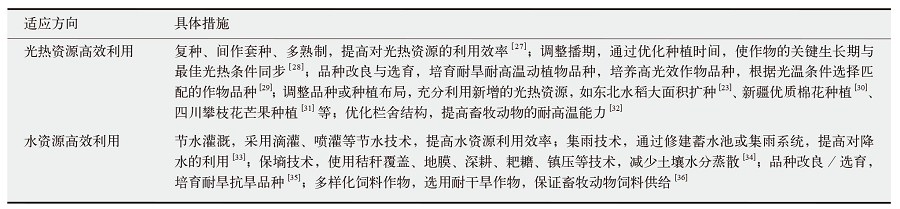
温升叠加CO2浓度升高的肥效作用,作物生物量增加、水分蒸腾量加大;气候变暖加剧土壤有机质的损失,导致土壤肥力下降[26]。已有的适应实践,在提高对光热资源的利用,以及匹配光热资源提升水资源利用效率方面开展了大量工作,取得的进展列于表2。但目前提高气候资源利用的适应技术,大多属于传统技术,适应灵活性有限。如调整播期,在实际操作中需要考虑作物生长所需积温,调整空间有限;并且气候变暖使作物物候期提前,而极端低温事件频率仍在增加,作物遭遇冻害的风险上升,可能导致播期调整的传统经验失败。品种改良/选育是目前提升作物气候韧性理想的方式之一,但是当前的育种周期通常较长,无法追赶上气候变化的速度,品种改良速度至少需要提升60%~110%,才能匹配未来温升2℃的情景[37]。除育种周期外,品种的适应性还受本地土壤和栽培管理技术的影响,配套栽培技术也需要一定周期的田间验证。因此,亟需技术研发和创新,缩短品种改良/选育周期,加快配套管理技术的研发。
表2 提高气候资源利用效率的主要适应措施
Table 2
 |
2.2 农业防灾减灾能力建设
表3 提高防灾减灾能力的主要适应措施
Table 3
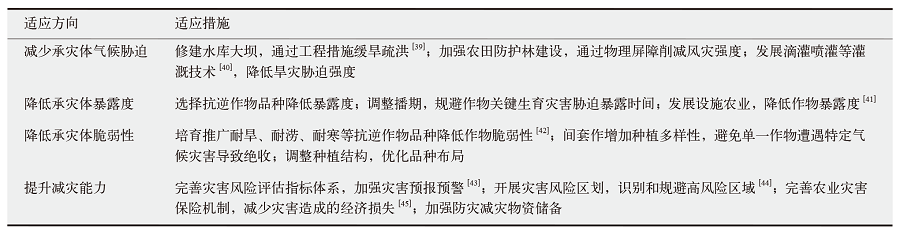 |
在种植业方面,承灾体适应极端事件的措施以种植结构调整、抗逆品种培育为主,属于常态化的减灾措施,其减灾机理为加强承灾体的适应能力,降低承灾体的脆弱性,但面对突发型极端灾害其减灾效果甚微[49]。随着全球变暖导致的气候胁迫日益加剧,减小农业承灾体暴露度的设施农业急剧发展。设施农业(如温室大棚)是充分利用光热资源、减轻气候灾害的重要措施,但如果建设标准低,则会进一步加剧气候灾害。2018年山东寿光遭受洪灾,1.8万个大棚被淹,反而加剧气象灾害,直接经济损失近10亿元。因此,要结合设施农业关键致灾因子分析,健全对设施农业的灾害风险评估。
2.3 生态治理能力建设
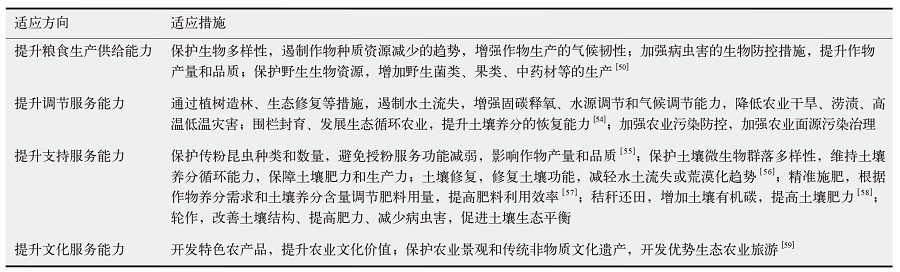
目前农业适应气候变化导致的生态后果研究较分散,多从农业种质资源保护、病虫害防控、土壤肥力保护和提升、农林复合系统减少气象灾害等方面开展[51-52],较少从生态系统服务的视角探究提升农业生态系统的供给、调节、支持和文化服务对提升农业气候韧性的重要性[53]。在提高农业生态系统供给服务方面,主要采取的气候变化适应措施体现在农业种植布局的调整以及适应性品种选育应用等(见表4)。农业生态系统恢复与治理,如水土保持工程、荒漠化治理和修复、土壤保护修复、农业污染防控、高标准农田建设等,能够恢复和提升农业生态系统调节服务,提高调节气候灾害的能力和支撑服务能力、增加农业生产系统的稳定性。在农业生态治理提升文化服务方面,采取的适应性措施包括开发绿色有机特色农产品、依托本地资源开发优势旅游产业以及将农业文化遗产保护同农民生计相结合,实现经济可持续发展。
表4 提高农业生态治理能力的主要适应措施
Table 4
 |
农业生态系统应对气候变化生态后果的研究是一个新兴的研究方向,耦合气候变化、农业和生态系统的研究存在诸多困难:(1)农业和生态观测及模型模拟存在空间及尺度差异性,由于长期的农业与生态过程监测研究数据不足,来自站点尺度的研究存在较高的区域特异性,缺乏跨区域、跨尺度的系统性分析,导致模型误差较大,无法量化生态保护与农业适应能力之间的关系;(2)缺少极端天气气候事件与农业适应措施对生态过程影响的机理研究,气候变化、农业和生态3个复杂系统之间的耦联机制缺乏认知;(3)缺少生物多样性保护与农业适应能力提升的定量研究,农业生物多样性保护多集中在种质资源和区域保护,缺少农业发展和生物多样性保护协同应对气候变化的解决方案。
2.4 适应气候变化管理能力建设
表5 提升农业气候风险管理能力的主要事项
Table 5
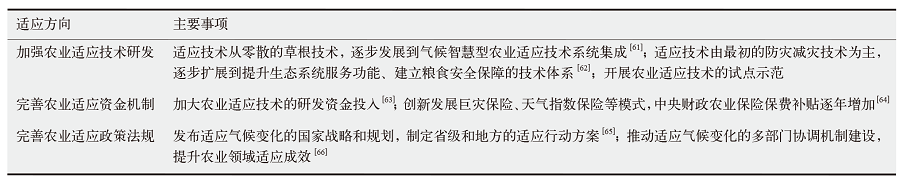 |
我国不断探索适应气候变化的资金机制,农业保险是规避农业气象灾害的重要措施。自2007年中央财政实施农业保险保费补贴政策以来,我国农业保险工作逐步发展,覆盖三大粮食作物、天然橡胶、油料作物等16个大宗农产品及60余个地方优势特色农产品,初步形成符合国情的农业保险机制[69]。2020年我国农业保险保费收入814.9亿元,同比增长21.2%,占总保费收入的1.8%;2024年,中央财政安排农业保险保费补贴预算达562亿元。
适应气候变化政策不断完善。3次气候变化适应国家政策文件的发布,基于最新的科学认知,不断梳理适应气候变化的逻辑层次和行动方向,强调动态适应、精准适应和区域差异化适应的重要性,不断融合科技创新强化农业适应气候变化的技术创新与突破。至2023年底,已有24个省(区、市)制定并发布了省级适应气候变化行动方案,中共中央、国务院及相关部委制定发布相关文件37份,涉及气候变化影响和风险评估、农业与粮食安全、综合防灾减灾、重大战略区域等多个适应气候变化的具体方面。基于适应行动的指导,黑龙江省因积温带北移重新划分种植区域,粮食作物面积从1980年的1.1亿亩(1亩≈667 m2)增至2021年的2.2亿亩,水稻、玉米等作物向北扩展2~3个纬度[23]。陕西省渭塬市苹果生产面对气温升高和极端天气频发胁迫,当地苹果种植户通过减少高风险作物面积、引入防雹网与滴灌系统、选育抗逆品种等方式应对气候变化。江西省根据气候变化特点及江西水稻种植结构变化需求,建立“再生稻+油菜”“双季稻+油菜”“中稻+油菜”等适宜区划指标,为江西稻油种植结构调整提供决策依据,在充分利用江西气候资源优势的前提下,有效避免了双季水稻农业气象灾害风险。山东省日照市气象局与地方财政、海洋、保险部门联合推出海洋牧场巨灾保险,为养殖牧场提供风险保障金2600万元;内蒙古锡林郭勒盟气象部门深耕肉羊天气指数保险服务,2024年肉羊投保规模增加近50%。
我国农业适应气候变化的综合支撑能力大幅提升,但当前我国适应气候变化的政策缺乏具体实施细则,执行力度不足,政策制定缺乏定量化的适应目标,适应行动降低气候风险的针对性不强。农业适应技术的研发资金和人才支持尤显不足,创新速度较慢,适应技术存在较大的区域局限性,难以推广大规模应用。
3 未来农业适应能力建设建议
在气候变化日益加剧的严峻态势下,农业生产正面临前所未有的系统性气候风险,亟需以科学评估为基础,精准识别适应优先事项,加速构建技术体系与规划框架,并大力提升全社会适应意识。面对适应行动严重滞后的现实,系统、协同、强化的多维度应对已刻不容缓。据此,提出以下建议:
系统评估农业气候风险。全球变暖不断加剧,农业生产面临越来越大的气候风险。在以往的适应实践中,大量的工作集中在减轻农业系统本身的脆弱性方面,但构成气候风险的气候胁迫越来越大,农业生产对象之于气候胁迫的暴露度越来越大,需要全面系统地评估农业生产的气候风险,这是“有的放矢”地提升农业适应能力、采取有效适应行动的科学基础。
甄别适应优先事项。增量适应和转型适应是适应气候变化的两种最基本的方式。增量适应采取渐进递增的适应对策,其核心是保持原有系统,在此基础上,对不匹配的部分进行增量修补;而转型适应则采取系统属性整体改变的适应方式,其核心是重建系统的架构与功能。转型适应代价巨大,但收益也同样丰厚。如果气候胁迫未超出临界值而采取增量适应,适应实践的一线工作者在很大程度上可以自行采取相应的适应措施;而采取转型适应的措施,则需要进行系统的设计,依靠坚实的科技支撑并由决策者和践行者通力合作实施完成。随着气候变化的加剧,今后可能需要更多地采取转型适应的方式,这就需要大力提升适应决策能力。
迫切需要构建农业适应气候变化技术体系。在我国发布的适应战略和规划政策文件中,多次提出要构建具有中国特色的适应技术体系,但这方面的工作进展缓慢,一方面是因为构建农业适应气候变化的科学支撑不足,另一方面也说明该项工作的难度之大。我国具有丰富的农业适应实践,积累了大量的草根适应技术,需要对这些技术措施进行系统的总结,集中攻关突破理论和方法学瓶颈,发展适应技术体系构建的理论框架与方法学体系。
制定农业适应气候变化规划。在两次发布的国家适应气候变化战略政策文件中,要求编制分领域的适应气候变化行动方案,但到目前为止,农业领域尚未制定专项适应规划。制定农业适应规划,需要系统地认识农业生产所面临的气候风险,甄别适应优先事项,评估当前适应差距,根据当前的经济社会发展水平确定合理的适应目标,选择切实可行的适应路径实现适应目标、分解适应任务。适应任务一方面是在当前已经开展的工作中加大气候韧性的增量事项,另一方面是为实现气候韧性增长目标而设计的专项适应任务。
大力提升适应气候变化的公众意识。鉴于当前适应行动严重滞后,2022年联合国环境规划署(UNEP)发布的适应差距报告⑤(⑤UNEP adaptation gap report 2022: too little, too slow: climate adaptation failure puts world at risk。)明确指出:行动太少,进展太慢。我国在2007年发布的《中国应对气候变化国家方案》中,提出了减缓与适应并重的原则。并重的原则,不意味着经费和工作量的平均分配。鉴于适应工作的艰巨性、复杂性,适应工作量几十倍甚至上百倍于减缓的资金和工作量,才能体现“并重”原则。当前应大力加强适应气候变化的科普宣传工作,提升全社会对适应工作重要性、紧迫性的认识。
参考文献
The adaptive capacity of maize-based conservation agriculture systems to climate stress in tropical and subtropical environments: a meta-regression of yields
[J].
《气候变化2014: 影响、适应和脆弱性》对农业气象学科发展的启示
[J].
Revelation of agro-meteorology learning from climate change 2014: impact, adaptation, and vulnerability
[J].
农业适应气候变化研究进展回顾与展望
[J].
Review on the research progress of agricultural adaptation to climate change and perspectives
[J].
气候变化对中国农业生产的影响初探
[J].
Possible impacts of climatic variation on agriculture in China
[J].
我国农业对全球变暖的敏感性和脆弱性
[J].
The sensitively and vulnerability of China’s agriculture to global warming
[J].
气候变化与农业: 最新的研究成果与政策考虑
[J].
Climate change and agriculture research findings and policy consideration
[J].
全球气候变化下中国农业的脆弱性与适应对策
[J].
DOI:10.11821/xb199603002
[本文引用: 1]

全球气候变化问题虽然还存在某些不确定性,但已得到广泛认同。对气候条件颇为敏感的农业将受影响,主要效应可概括为:①农业地理限制的变动;②作物产量的变化;③对农业系统的冲击。中国农业对气候变化与波动尤其敏感,加之人口压力进一步加大和农业资源已很紧缺,粮食自给的能力将受到严重威胁,必须充分重视适应和调整对策的研究。变动性与不确定性是气候的固有特征,在评价全球气候变化对农业的影响时应该认识到这点。本文还提出了减少农业对气候变化脆弱性的建议。
Sensitivity and adaptation of Chinese agriculture under global climate change
[J].
DOI:10.11821/xb199603002
[本文引用: 1]
Historically,China has experienced numerous climatic changes or variations.In the last hundred years,it seems that China’s climate has become generally warmer and drier.Temperature increases have been Particularly notable in the north,with less evidence of changes in South China.Records show an obvious drying trend in eastern and northwestern China since 1910.Estimations for the future climatic change include:(1) Most Parts of China l be warmer in 1990s, cooler during 2010 2030,and warmer again after 2040.(2)The greenhouse warming would strengthen the warmer period,hence the average temperature will ne in the next century,about 2℃ higher during the warmest period than that at present.In the warming process,however,there would be fluctuations in a temporal scale of 20 30years and with a extent of 0.5 1.0℃.(3)The precipitation will decrease in the east and increase in the west.China’s agricultural vulnerability to climatic change is amplified by the high degree of dependeuce on a diminishing agricultural resources base.DEspite its vast size.China is poor in agricultural resources per capita,especially cropland and water resources.On the other hand,the population will increase.So the cropland per capita will be even less.Furthermore,the productivity of cropland is hindered by water shortages.This moisture constraint on food prduction is likely to be aggravated by climate change.Investment and technology are important in adapting to climatic change.However,China’s prospects for investment and technological development in agriculture are relatively modest.There fore,the Capital put into agriculture is limited.With huge rural populations but relatively scarce scientists and technicians and with inadequate equipment in agriculture, China has very limited prospects for technological adaptation to climatic change.Most researchers agree that global climate change would impact greatly on Chinese agriculture,whatever the regional climate change may be,because Chinese agriculture is already sensitive to climate-related conditions.At least,the followings will occur:(1) A loss at least 5% of overall agricultural production as aresult of warming,because of increased evaporation.wind erosion of soil,drought,and increased frequency of typhoons.(2) Several forest species face serious losses and some forest areas will be converted to steppe,covered by non-productive hot or warm-natured shrubs and grasses.(3) Significant damage to coastal areas from even a moderate sea level rise would occur,with extensive flooding and destruction of existing salterns farm-land and fishery farms,that large food sources for coastal China.In regard to deltas,where the most productive land is found and the densest population and the richest infrastructure and settlement in China are located,half of the Zhujiang River-Delta,abut 3500 square kilometers,might be inundated,and wide scale flooding is projected for more developed areas of the Changjiang River and Huanghe River deltas.Thus the food production in China will be challenged greatly and this will happen at a time when Chinese population and living standards are increasing greatly.The future national security of food sufficiency would be in more uncertainty.The feasibility of production may shrink,the flexibility of resource-use would be less,and the vulnerability would be increased.Concerns over potential agricultural impacts of clmatic change have promoted consideration of adsptations.The question of adaptation has been approached in two ways. First,It is likely that farmers and rural communities,when faced with changed climatic conditions,will adjust their practices.Thus,any estimate of agricultural implications of changes in climate needs to consider possible "spontaneous" adaptive strategies,and the prospects for their adoption.Second.in the face of crop losses or new production opportunities associated with climatic change,public authorities may promote adjustments in the nature and organization of agricultural production,in order to minimize climate-related losses and to realize potential be
气候及其变率变化对东北地区粮食生产的影响
[J].
Impacts of changes in both climate and its variability on food production in Northeast China
[J].
气候变化对小麦生物量影响的概率预测和不确定性分析
[J].
DOI:10.11821/xb201203005
[本文引用: 1]
气候变化对农业生产的影响和适应一直是学界关注的重点。但是,由于气候模式输出、排放情景、尺度转换、模型参数化等研究过程中存在的不确定性,往往导致研究结果也存在较大的不确定性。为减少研究结果的不确定性,本研究综合了IPCC 四个排放情景(A1FI、A2、B1、B2) 以及5 个全球气候模式(HadCM3, PCM, CGCM2, CSIRO2, ECHAM4) 的输出结果,基于英国CRU 气候中心的20 个未来情景数据库,生成全球平均温度升高1℃(GMT+1D)、2℃ (GMT+2D)、3℃ (GMT+3D) 下研究站点的气候日值中值情景数据,利用过程模型CERES-Wheat 和概率预测方法研究CO<sub>2</sub>肥效作用和GMT+1D、GMT+2D、GMT+3D对我国小麦主产区小麦生物量的影响。研究结果表明:CO<sub>2</sub>肥效作用可以补偿由于温度升高而造成的小麦生物量减产且补偿作用随着温度的升高而增加。当有CO<sub>2</sub>肥效作用时,灌溉小麦和雨养小麦生物量均增加,且随着温度的升高生物量的增长程度增大,相同情景下,雨养小麦生物量的增高概率大于灌溉小麦。当不考虑CO<sub>2</sub>肥效作用时,灌溉小麦和雨养小麦生物量均降低,且灌溉小麦生物量减产的概率大于雨养小麦减产概率。
Probabilistic assessment and uncertainties analysis of climate change impacts on wheat biomass
[J].
DOI:10.11821/xb201203005
[本文引用: 1]
Impacts of climate change on agriculture and adaptation are of key concern of scentific research. However, vast uncertainties exist among the global climate models (GCMs)output, emission scenarios, scale transformations, crop model parameteration-simulated outputs. In this study, a probabilistic approach is used to reduce the uncertainties, from 20 climate scenarios output (including four emissions scenarios of A1FI, A2, B1 and B2, and five GCMS of HadCM3, PCM, CGCM2, CSIRO2 and ECHAM4) from the Intergovernmental Panel on Climate Change Data Distribution Centre. We adapt the median values of projected changes in daily mean climate variables for representative stations and drive the CERES (Crop Environment Resource Synthesis)-Wheat model to simulate wheat biomass under baseline condition and global warming scenarios of global mean temperature (GMT) increase of 1 ℃ (GMT+1D), 2 ℃ (GMT+2D) and 3 ℃ (GMT+3D), with and without consideration of CO<sub>2</sub> fertilization effects, respectively. Our study results show that elevated CO<sub>2</sub> concentration generally compensate for the negative effects of warming temperatures on wheat biomass and the positive effects of elevated CO<sub>2</sub> concentration on wheat biomass increase with warming temperatures. There is a high probability of increasing wheat biomass under higher temperature scenarios in consideration for CO<sub>2</sub> fertilization effect and rain-fed wheat biomass increase are higher than rain-fed wheat biomass under the same temperature rising scenarios. Due to increase in temperature, projected wheat biomass for GMT + 1D, GMT+2D and GMT+3D would reduce without consideration of CO<sub>2</sub> fertilization effects and irrigated wheat biomass would reduce more than rain-fed wheat biomass under the same temperature rising scenarios.
全球气候变化下黄土高原泾河流域近40年的气候变化特征分析
[J].
Variations of the climatic characteristics in the past 40 years of Jinghe River basin, Loess Plateau of China
[J].
全球气候变暖对中国种植制度可能影响 I.气候变暖对中国种植制度北界和粮食产量可能影响的分析
[J].
The possible effects of global warming on cropping systems in China I. The possible effects of climate warming on Northern limits of cropping systems and crop yields in China
[J].
气候变化对中国农业生产影响的模拟评价进展
[J].
Advances of evaluation of climate change impact on crop yield
[J].
用GIS和作物模型对作物生产进行区域模拟研究
[J].
Spatial crop yield simulation using GIS-based crop production model
[J].
未来10年黄土高原气候变化对农业和生态环境的影响
[J].
The impacts of future climatic change on agricultures and eco-environment of Loess Plateau in next decade
[J].
东北地区农业及环境对气候变化的响应与应对措施
[J].
Response and adaptation to climate change of agriculture and environment in Northeast China
[J].
气候变化对我国农业的可能影响及适应性对策
[J].
Impact of climatic change on agriculture and its adaptation countermeasures in China
[J].
气候变化对中国农业的影响
[J].
Impact of changing climate on agriculture in China
[J].
Effects of climate change on paddy expansion and potential adaption strategies for sustainable agriculture development across Northeast China
[J].
Climate-mediated dynamics of the northern limit of paddy rice in China
[J].
Increasing inconsistency between climate suitability and production of cotton (Gossypium hirsutum L.) in China
[J].
我国芒果种植气候适宜性区划
[J].
Climatic suitability regionalization of mango cultivation in China
[J].
Projected soil carbon loss with warming in constrained Earth system models
[J].
中国粮食作物气候资源利用效率及其提高的途径
[J].
Climatic resources utilization coefficiency of cereal crops in China and development measures
[J].
中国北方气候暖干化对粮食作物的影响及应对措施
[J].
Impact of climate warming and drying on food crops in northern China and the countermeasures
[J].
1980—2019年中国粮食主产区主要粮食作物气候生产潜力与气候资源利用效率
[J].随着全球性极端气候频发,粮食生产安全越来越受到气候变化的威胁。在此背景下,实现农业气候资源的高效持续利用意义重大。粮食主产区是粮食安全保障的核心区域,本文应用逐级订正的机制法模型测算了1980—2019年中国粮食主产区玉米、水稻、小麦三大主要粮食作物的气候生产潜力,并应用重心迁移模型分析了粮食主产区186个地级市现实作物生产水平与气候生产潜力的时空属性,在市域尺度上评估了农业气候资源利用效率。研究得出:①1980—2019年粮食主产区玉米、水稻、小麦气候生产潜力的倾向率分别为-156.80、68.82、121.92 kg/(hm<sup>2</sup>·10 a);②玉米气候生产潜力高值区和低值区范围均缩小,水稻气候生产潜力空间结构较为稳定,小麦气候生产潜力高值区范围扩大;③主要粮食作物气候生产潜力的重心迁移距离均小于现实迁移距离,并呈同向化特征;④黄淮海农业区、东北农业区、西南农业区等地主要粮食作物气候资源利用率较高,长江中下游农业区等地气候资源利用率较低。对此,应调整粮食生产重心,缓解气候条件较差地区的粮食生产压力,挖掘气候资源丰富地区的气候生产潜力,全面提高粮食主产区气候资源利用效率。
Climatic potential productivity and resources utilization efficiency of major grain crops in the main grain production areas of China
1980-2019 [J].Food production has been increasingly threatened by the frequent occurrences of global extreme climate. Under this background, it is of great significance to realize the efficient and sustainable utilization of agricultural climatic resources. The main grain production areas in China are a core region for food security of the country. This study empirically calculated maize, rice, and wheat crop climatic potential productivities in the main grain production areas of China from 1980 to 2019 by using step-correcting mechanism model, and analyzed the spatial and temporal dynamics of actual production level and climatic potential productivity in 186 cities in these areas by using a gravity center shift model. It also comprehensively assessed agricultural climatic resources utilization efficiency at the city scale. Important results are as follows: (1) Tendency rate of maize, rice, and wheat crop climatic potential productivity in the main grain production areas of China from 1980 to 2019 was -156.80 kg/(hm2·10 a), 68.82 kg/(hm2·10 a), and 121.92 kg/(hm2·10 a) respectively. (2) Spatial change of climatic potential productivity showed three characteristics higher and lower maize climatic potential productivity areas both narrowed; spatial structure of rice climatic potential productivity basically remained unchanged; and higher wheat climatic potential productivity area enlarged. (3) Gravity centers of actual production level and climatic potential productivity changed in the same direction and the distance of migration of climatic potential productivity gravity center was shorter than that of actual production level. (4) Agricultural climatic resources utilization efficiency was higher in the agricultural areas of the North China Plain, Northeast China, and Southwest China, and agricultural climatic resources utilization efficiency was lower in the agricultural area of the Lower Yangtze Region. Therefore, it is necessary to adjust the focus of grain production. The utilization efficiency of climatic resources in the main grain producing areas can be comprehensively improved by alleviating the pressure of grain production in areas with poor climatic conditions, and tapping the climatic potential productivity of areas with rich climatic resources.
利用气候变暖趋势大力发展黑龙江省的粮食生产
[J].
On the utilization of climate warming to promote vigorously food production of Heilongjiang province
[J].
近50年贵州省气候生产潜力时空变化特征
[J].
Spatiotemporal variation of climatic potential productivity in Guizhou province in the last 50 years
[J].
山西省玉米气候资源利用效率分析
[J].
Analysis of climatic resources utilization efficiency of maize in Shanxi province
[J].
气候变化背景下东北三省主要粮食作物产量潜力及资源利用效率
[J].
以东北地区喜温作物和喜凉作物的潜在种植区为研究区域,基于研究区域内65个气象台站1961—2010年地面气象观测数据,结合作物生育期资料,应用作物产量潜力逐级订正法,分析不同作物各级产量潜力时空分布特征,明确作物各级产量潜力受气候资源限制程度,比较气候资源利用效率差异.结果表明: 1961—2010年,东北三省6种作物(玉米、水稻、春小麦、高粱、谷子和大豆)的光温产量潜力呈明显的西高东低的空间分布特征,作物气候产量潜力除春小麦外其他作物均呈现南高北低的空间分布规律.6种作物受温度限制的产量潜力损失率呈东高西低的空间分布特征,大豆受温度限制引起的产量潜力损失率最高,平均为51%,其他作物为33%~41%;因降水制约引起的潜力损失率分布有明显的区域性差异,在松嫩平原和长白山区各有一个高值区,春小麦因降水亏缺引起的产量潜力损失率最高,平均为50%,其他4种雨养作物集中在8%~10%.东北三省各作物生长季内光能利用效率在0.9%~2.7%,其中玉米>高粱>水稻>谷子>春小麦>大豆;雨养条件下,玉米、高粱、春小麦、谷子和大豆各作物的降水利用效率在8~35 kg·hm<sup>-2·</sup>mm<sup>-1</sup>,其中玉米>高粱>春小麦>谷子>大豆.在光能利用效率和降水利用效率均较低的长白山区和小兴安岭南部地区,可采取合理密植、选择适宜品种、适时施肥、蓄水保墒耕作以及优化作物布局等措施提高资源利用效率.
Comparison of potential yield and resource utilization efficiency of main food crops in three provinces of Northeast China under climate change
[J].
气候变化背景下未来中国气候生产潜力时空动态格局
[J].
Temporal-spatio dynamic pattern of climatic potential production under the background of climate change in the future in China
[J].
近50 年气候变化对青藏高原青稞气候生产潜力的影响
[J].
Influence of climate change on potential productivity of naked barley in the Tibetan Plateau in the past 50 years
[J].
全球气候变化下中国农业生产潜力的空间演变
[J].
Temporal and spatial variation of the potential agricultural productivity of China under global climate change
[J].
DOI:10.11849/zrzyxb.2015.12.005
Potential agricultural productivity has an important and far-reaching impact on re-gional agricultural development and agriculture industrialization investment and distribution. However, previous researches paid more attention to exploring the potential agricultural productivity in some regions of China, but the temporal and spatial variation of regional potential agricultural productivity in China have yet to receive the attention they deserve. Furthermore, more importantly, the study regarding the impact of climate change on the potential agricultural productivity and the spatial pattern of Chinese agricultural development are relatively small in China. Therefore, in allusion to the problems mentioned above, based on the GIS method, this paper analyzes the temporal and spatial characteristics of regional potential agricultural productivity of China since 1980s, and discusses the impact of climate change on potential agricultural productivity and food production in China between 2041 and 2060. Results mainly show that the regional potential agricultural productivity in southeastern China is higher than that of other parts of China between 1961 and 2012, and the lowest potential agricultural productivity is found in northwestern China. However, the averaged potential agricultural productivity is less than 7500 kg/hm; 2 in west regions of the HU-line in China. At the same time, spatial distribution of the averaged potential agricultural productivity in China between 1961 and 2012 clearly presents the characteristics of latitude zonality. In addition, by comparing two periods of 1961-1980 and 1981-2012, the decline of the potential agricultural productivity is mainly found in areas east of the HU-line, and the largest declines are found in Sichuan Basin and in the middle of North China Plain, falling by more than 4%. Notably, however, the biggest contributing factor leading to reduce of potential agricultural productivity in these regions is the availability coefficient of water. Moreover, the middle and lower reaches of the Yangtze River and the south of North China Plain are characterized by increasing potential agricultural productivity. Finally, the simulated results suggest that the decline in the potential agricultural productivity of China between 2041 and 2060 can be mainly found in the area south of the Yangtze River and in the middle of Qinghai under the context of global climate change, where Sichuan Basin, southern and central Hubei would be the most declined regions in potential agricultural productivity, which means that future climate change may have a significant negative effect on food production in these regions.
Climate change may out pace current wheat breeding yield improvements in North America
[J].
内蒙古农牧交错区孕灾环境特征及气象灾害风险辨识
[J].
Risk distinction of main meteorological disasters and characteristics of disaster-forming environments in interleaving areas of agriculture and pasture in Inner Mongolia
[J].
气候变化背景下中国重大农业气象灾害预测预警技术研究
[J].
Research on the prediction and early warning technology of major agricultural meteorological disasters in China under the background of climate change
[J].
近十年国家级农业气象灾害预报评估业务技术进展
[J].
Advance in operational technology of agrometeorological disaster forecasting and assessment in China in recent 10 years
[J].
暴雨灾害风险及其对农业影响的评估
[J].
Assessment on storm disaster risk and its impact on agriculture
[J].
基于干旱灾害风险综合评估指数的西藏主要农区青稞干旱时空格局
[J].
DOI:10.11924/j.issn.1000-6850.casb20200200107
为研究西藏主要农区青稞的干旱时空变化特征,笔者从干旱灾害的致灾因子危险性、承灾体易损性、灾损脆弱性、防灾减灾能力等4个风险因子考虑,采用专家打分法和熵权法确定各因素权重,构建干旱灾害风险综合评估模型,并进行干旱灾害时空格局分析。结果表明:干旱灾害综合风险整体呈现中间低、两边高的态势,高风险区分布比较分散,次高风险区多集中在研究区的边缘地带,中等风险区以左斜H型分布在拉萨、山南、林芝市部分区域,而次低和低风险区零星分布在加查、索县、比如、林芝等站;且干旱灾害风险较高年份出现在1999、2005、2006、2007、2009、2010、2012、2014、2015年。西藏主要农区青稞各个干旱风险因子的分布具有明显的区域差别和一定的连片性,研究区和分区的干旱趋势随年份递增而加重。
Temporal and spatial patterns of Barley in Tibet major agricultural areas based on the comprehensive assessment index of drought disaster risk
[J].
DOI:10.11924/j.issn.1000-6850.casb20200200107
To study the spatiotemporal changes of drought of barley in the main agricultural areas of Tibet, the authors took four risk factors, including the danger of drought disaster, the vulnerability of disaster victims, the vulnerability of disaster, and the ability to prevent and mitigate disaster, and adopted the expert score method and entropy weight method, to determine the weight of each factor to construct a comprehensive assessment model for drought risk and analyze the spatial and temporal pattern of drought disaster. The results showed that: the overall risk of drought disasters was generally low in the middle and high on both sides. The distribution of high-risk areas was relatively scattered. The sub-high-risk areas were mostly concentrated in the marginal zones of the study area. The middle-risk areas were distributed with left-sloping H-shape in parts of Lhasa, Shannan, and Linzhi, while the sub-low-risk and low-risk areas were scattered in Jiacha, Suoxian, and Linzhi stations; and the years with higher risk of drought disaster appeared in 1999, 2005, 2006, 2007, 2009, 2010, 2012, 2014, and 2015. The distribution of drought risk factors for barley in major agricultural areas in Tibet has obvious regional differences and a certain degree of continuity, and the drought trend in the study area and subdivision increases with each year.
基于概率统计方法的承德市农业旱灾风险评估
[J].
Assessing agricultural drought disaster risk in Chengde city using stochastic method
[J].
变暖环境下华北地区农业气象灾害风险评估I: 基于综合指标体系法农业干旱风险评估及适应对策建议
[J].
Risk assessment of agrometeorological disasters in North China under warming environment I: agricultural drought risk assessment and adaptation countermeasures based on comprehensive index system method
[J].
1978—2020年中国农业气象灾害时空格局解析
[J].
Spatiotemporal variations of agricultural meteorological disasters in China during 1978-2020
[J].
台湾海峡西岸红树林的气候变化综合风险评估
[J].
Comprehensive risk assessment of climate change for mangroves on the west coast of the Taiwan Strait
[J].
农业气象灾害知识图谱构建研究进展
[J].
Research on the construction of knowledge graphs for agricultural meteorological disasters: a review
[J].
DOI:10.3969/j.issn.1000-6362.2024.10.11
[本文引用: 1]
<p class="18"> Efficient utilization of massive heterogeneous data is <span>the</span> key factor to enhance the intelligence of agricultural disaster management. <span>Therefore, it is important to explore techniques for constructing multi-source heterogeneous agricultural meteorological disaster knowledge graphs for dynamic monitoring of agricultural meteorological disasters and intelligent management decision making. </span>This paper analyze<span>d</span> <span>the data sources, types, and characteristics required for knowledge graph construction in the agricultural meteorological disaster domain through literature studies and proposed a framework for knowledge graph construction that combined top-down and bottom-up approaches.</span> The paper also examine<span>d</span> key <span>techniques </span>and the current application status of knowledge graph construction from the perspective of schema layer construction, entity extraction, relation extraction, and knowledge fusion. <span>In addition</span>, it explore<span>d</span> the applications of agricultural meteorological disaster knowledge graphs in the fields of monitoring and early warning, risk assessment, intelligent service, and decision support. It summarize<span>d</span> the challenges of constructing agricultural meteorological disaster knowledge graphs and discusse<span>d</span> the future development directions. Integrating information from the different modalities <span>could</span> make knowledge graph more comprehensive and accurate in describing and expressing the knowledge and information in the field of agricultural meteorological disasters, which <span>could</span> help to mitigate the losses caused by agricultural meteorological disasters and improve the accuracy and efficiency of decision-making. In the future, agricultural meteorological disaster knowledge graph will be constructed <span>b</span>y incorporating large language models, advanced knowledge extraction methods to achieve complex entity and relationship extraction, and multi modal data. <span>Further research is needed to advance the technical study of agricultural meteorological disaster knowledge graph.</span></p>
气候变化对农业地域系统的影响及其应对
[J].
The impact of climate change on agricultural territorial systems and their responses
[J].
气候变化对农业生态系统服务的影响及适应对策
[J].
A review of the impacts of climate change on agro-ecosystem services and adaptation measures
[J].
DOI:DOI: 10.13292/j.1000-4890.202303.026
[本文引用: 1]
Due to the vulnerability of agro-ecosystems, climate change poses great challenges to the sustainable provision of agro-ecosystem services. Previous studies have analyzed the impacts of climate change on agroecosystems. However, integrative studies about the influences of climate change on agro-ecosystem services and relevant adaptation actions are still rare. In this paper, we reviewed the impact mechanisms of climate change on crop yield, stability of regulating services, and supply of cultural services, as well as the current adaptation measures from the perspective of agricultural landscape diversity. We proposed to deepen research on the comprehensive impacts of climate change on multiple ecosystem services, explore the adaptation mechanisms of agro-ecosystems to climate change, strengthen studies of model simulation, and strengthen the connection between adaptation measures and government decision-making. This review provides scientific evidence for national agricultural policy-making and action implementation on climate change in China.
Priority science can accelerate agroforestry as a natural climate solution
[J].
Climate change exacerbates the environmental impacts of agriculture
[J].
Adapting crop production to climate change and air pollution at different scales
[J].
DOI:10.1038/s43016-023-00858-y
PMID:37845546
[本文引用: 1]
Air pollution and climate change are tightly interconnected and jointly affect field crop production and agroecosystem health. Although our understanding of the individual and combined impacts of air pollution and climate change factors is improving, the adaptation of crop production to concurrent air pollution and climate change remains challenging to resolve. Here we evaluate recent advances in the adaptation of crop production to climate change and air pollution at the plant, field and ecosystem scales. The main approaches at the plant level include the integration of genetic variation, molecular breeding and phenotyping. Field-level techniques include optimizing cultivation practices, promoting mixed cropping and diversification, and applying technologies such as antiozonants, nanotechnology and robot-assisted farming. Plant- and field-level techniques would be further facilitated by enhancing soil resilience, incorporating precision agriculture and modifying the hydrology and microclimate of agricultural landscapes at the ecosystem level. Strategies and opportunities for crop production under climate change and air pollution are discussed.© 2023. Springer Nature Limited.
1999—2013年中国耕地复种指数的时空演变格局
[J].
Spatial and temporal variations of multiple cropping index in China based on SPOT-NDVI during 1999-2013
[J].
Ecosystem services and economic development in Austrian agricultural landscapes the impact of policy and climate change scenarios on trade-offs and synergies
[J].
气候和土地利用变化影响下生态屏障带水土流失趋势研究
[J].
Changes in soil erosion and its driving factors under climate change and land use scenarios in Sichuan-Yunnan-Loess Plateau region and the Southern Hilly Mountain Belt, China
[J].
西部生态脆弱区农业面源“白色污染”系统治理策略研究
[J].
Research on coordinated control strategy for agricultural non-point source “white pollution” in western ecological fragile area
[J].
农业文化遗产地游客环境责任行为与饮食旅游偏好关系研究: 以浙江青田稻鱼共生系统为例
[J].
Relationship between tourists’ environmental responsibility behavior and food preference in agricultural heritage sites: a case study of Qingtian rice-fish culture system
[J].
多尺度农业生态系统服务研究进展
[J].
Research progress and prospects of multi-scale agroecosystem services
[J].
关于气候变化对社会经济系统影响的机理和途径的探讨
[J].
The impact of climate change on the socioeconomic system: a mechanistic analysis
[J].
适应领域应对气候变化的重点领域与技术需求研究
[J].
Key fields and technology needs for climate change adaptation
[J].
我国气候贫困问题的现状、成因与对策
[J].
The status quo, causes and countermeasures of China’s climate poverty
[J].
气候变化影响链的形成机制及其应对
[J].
Mechanism on the formation of climate change impact chain and its responses
[J].
DOI:10.3969/j.issn.1000-6362.2021.12.001
Once climate change brings various stresses and disturbances on the receptor system, the receptor system will transfer these stresses and disturbances to other systems through its connection with them, resulting in the continuous extension of climate change effects in time and space, forming a complex climate change impact chain. At present, studies on the impacts of climate change mostly focus on the direct impacts, while the indirect impacts are rarely considered. The incomplete understanding of the impact transmission of climate change is one of the main constraints in addressing climate change. It is of great significance to explore the formation mechanism of the impact chain of climate change. This research analyzed the characteristics of climate change impacts, explored the formation mechanism of climate change impact chains, defined the connotation and classification of climate change impact chains, clarified the impact levels of climate change, and proposed ways to cope with climate change impact chains. The results showed that the impacts of climate change were extensive, different, persistent, transferable, transformable, and sometime sudden. When climate change acted on the direct receptors, the impacts of climate change would be transmitted along the food chain in the ecosystem, along the industrial chain in the economic system, and along the social relationship chain in the social system. The transmission of impact chain took the form of material flow, energy flow and information flow. The impacts of climate change always rose from low to high levels, along changes in resource endowments to natural production, economic production systems and social systems. It is believed that the effective control or cutting off of the transmission of adverse impacts of climate change can effectively reduce the impact risks and losses of climate change. The impact chain of climate change and its formation mechanism provide ideas and approaches for people to deal with climate change comprehensively.
人地系统适应性研究进展: 概念、理论框架与方法
[J].
DOI:10.18306/dlkxjz.2021.02.013
适应性研究旨在通过主体对外部环境变化的调整,以削减其负面影响并改善适应能力,是实现人地系统可持续发展的重要途径。鉴于目前对适应性理论体系缺乏统一认识和系统梳理,论文通过对国内外人地系统适应性研究文献总结,从概念内涵、理论框架和方法对适应性研究进展进行了总结,并提出了适应性研究的科学范式。研究发现:① 学术界对适应性概念的理解并未达成科学共识,阻碍了通用的适应性研究理论体系的构建。② 现有适应性分析框架多是基于全球变化领域理论框架基础的延伸和修订。③ 适应性研究缺乏具有代表性的方法,以借用脆弱性、恢复力评估方法和指标体系为主。因此,统一的适应性概念和理论体系的构建亟需加强,而国外既有积累的理论经验并不通用,中国化的适应性分析框架、方法是未来的重要研究方向。同时,应强化人类社会和自然环境“综合”的人地系统适应性研究,注重多尺度结合的适应性动态分析。
Progress of research on adaptation of human-environment systems: concepts, theoretical frameworks, and methods
[J].
DOI:10.18306/dlkxjz.2021.02.013
The purpose of adaptation research is to reduce the negative effects of external environment and improve adaptation through the adjustment of the subject to the changes of the external environment, which is an important way to realize the sustainable development of human-environment systems. In view of the lack of a unified understanding and systematic review of the adaptation theories, this article summarized the progress of research on adaptation from the concepts, theoretical frameworks, and methods by examining the literature on adaptation of human-environment systems in China and internationally, and put forward a scientific paradigm of adaptation research. The findings are as follows: 1) There is no scientific consensus on the concept of adaptation in academia, which hinders the construction of a general theoretical system of adaptation research. 2) The existing analytical frameworks of adaptation are mostly based on the extension and revision of the theoretical framework in the field of global change. 3) There is no representative method in adaptation research, which mainly uses vulnerability and resilience assessment methods and index systems. Therefore, the construction of a unified concept and theoretical system of adaptation needs to be strengthened. The existing theoretical research in other countries may not be universally applicable, and an analytical framework and method of adaptation research specifically useful in China should be an important research direction in the future. Simultaneously, it is necessary to strengthen the research on integrated adaptation of human-environment systems considering both human society and the natural environment, and pay attention to the dynamic analysis of adaptation with a combination of multiple scales.
气候变化的社会经济影响实证研究综述
[J].
A review of empirical studies on socio-economic impact of climate change
[J].
生物育种技术在传统种业转型中的创新应用路径
[J].
Innovative application path of bio-tech breeding in the transformation of traditional seed industry
[J].
可持续发展目标下气候智慧型农业: 概念辨析、基本议题和中国实践启示
[J].
Climate-smart agriculture under the sustainable development goals: concept discrimination, basic issues and implications from China’s practice
[J].


