Climate Change Research ›› 2025, Vol. 21 ›› Issue (5): 659-670.doi: 10.12006/j.issn.1673-1719.2025.023
• Impacts of Climate Change • Previous Articles Next Articles
Ensemble projection of changes in the ecosystem exposure to heatwaves over mid-high latitude Asia
SUN Xiao-Ling1,2( ), XIE Wen-Xin1, ZHOU Bo-Tao1()
- 1
State Key Laboratory of Climate System Prediction and Risk Management/Key Laboratory of Meteorological Disaster ,Ministry of Education/Collaborative Innovation Center on Forecast and Evaluation of Meteorological Disasters, Nanjing University of Information Science and Technology Nanjing 210044, China
2Jinan High-Tech Industrial Development Zone Weather Station Jinan 250102, China
-
Received:2025-02-05Revised:2025-03-27Online:2025-09-30Published:2025-09-22

Cite this article
SUN Xiao-Ling, XIE Wen-Xin, ZHOU Bo-Tao. Ensemble projection of changes in the ecosystem exposure to heatwaves over mid-high latitude Asia[J]. Climate Change Research, 2025, 21(5): 659-670.
share this article
Add to citation manager EndNote|Ris|BibTeX
URL: https://www.climatechange.cn/EN/10.12006/j.issn.1673-1719.2025.023
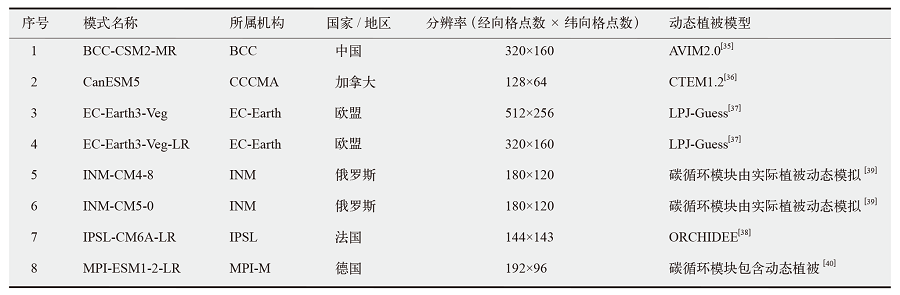 |
Table 1 Basic information of 8 CMIP6 models used
| |

Fig. 1 Schematic diagram of the study area
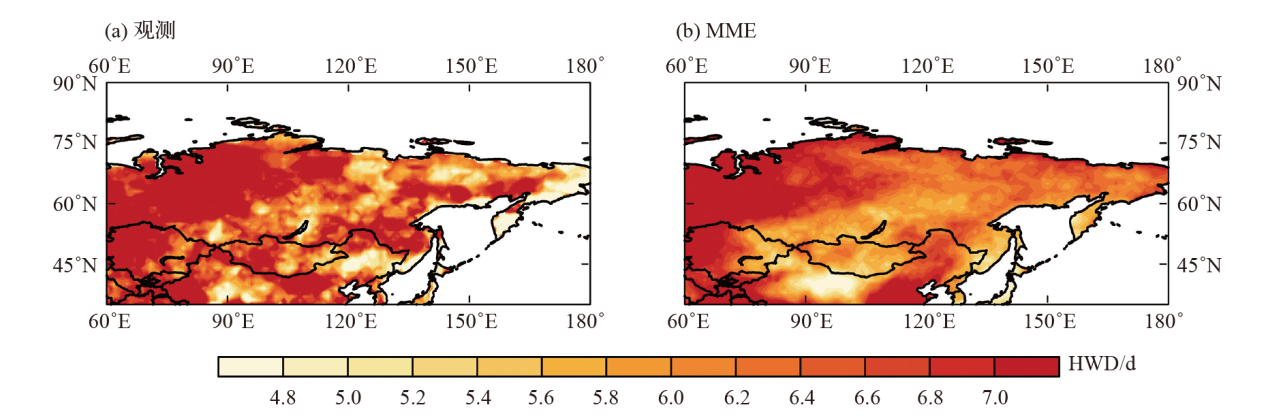
Fig. 2 Climatological distribution of observed (a) and MME simulated (b) HWD during 1995-2014
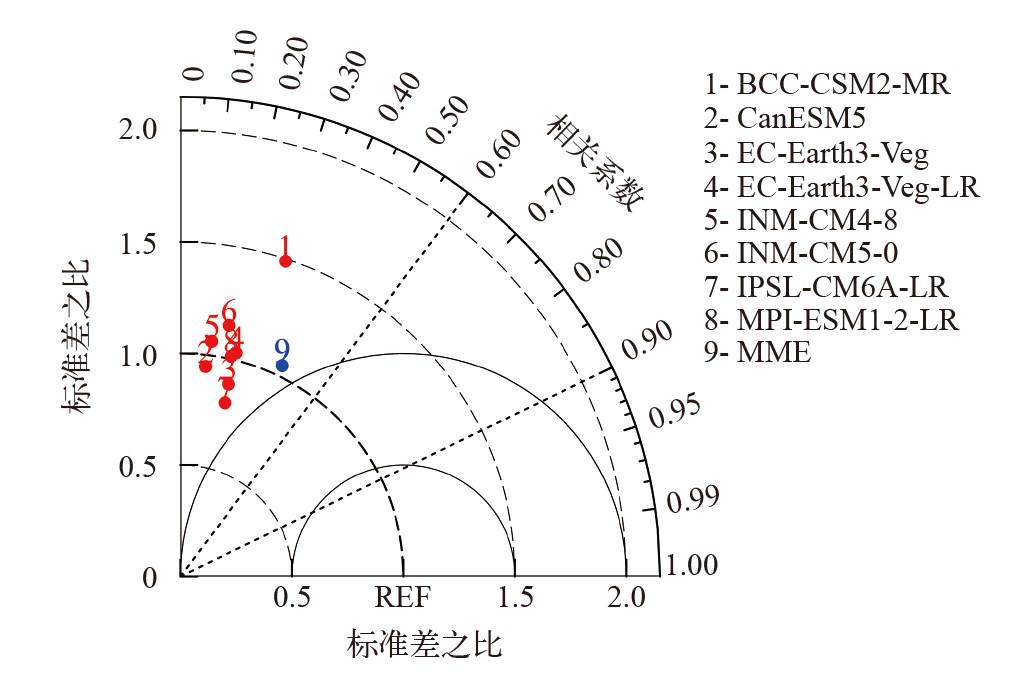
Fig. 3 Taylor diagram of CMIP6 models referring the climatological distribution of annual mean HWD over mid-high latitude Asia during 1995-2014
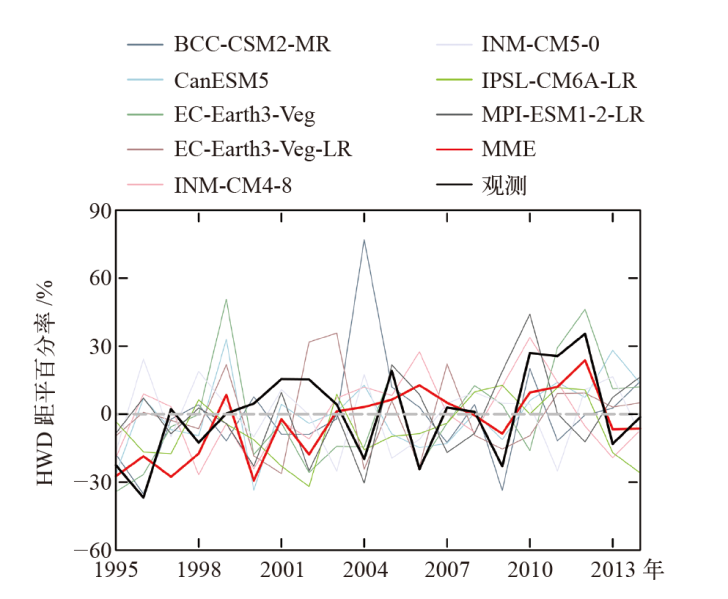
Fig. 4 Time series of observed and MME simulated annual mean percentage of HWD anomaly over mid-high latitude Asia during 1995-2014
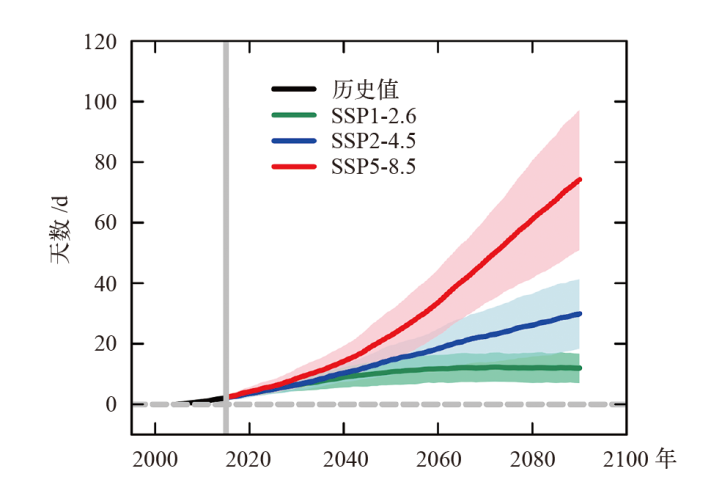
Fig. 5 Temporal changes in HWD averaged over mid-high latitude Asian under SSP1-2.6, SSP2-4.5, and SSP5-8.5 (relative to 1995-2014, the same below). (Time series are smoothed with a 20-year running mean filter, and shadings represent the ranges of two standard deviations of model simulations)
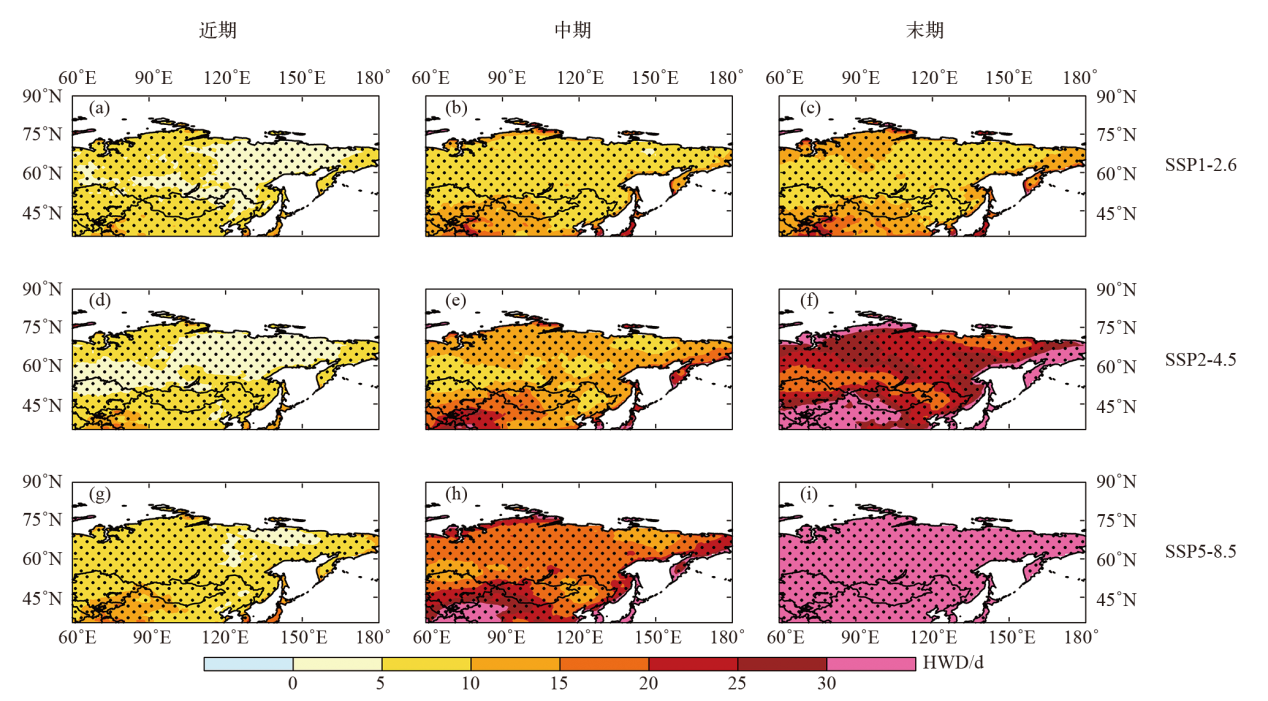
Fig. 6 Spatial distribution of the MME projected changes in HWD during 2021-2040, 2041-2060, and 2081-2100 under SSP1-2.6, SSP2-4.5, and SSP5-8.5. (Areas with the changes above the 0.05 significance level are dotted)
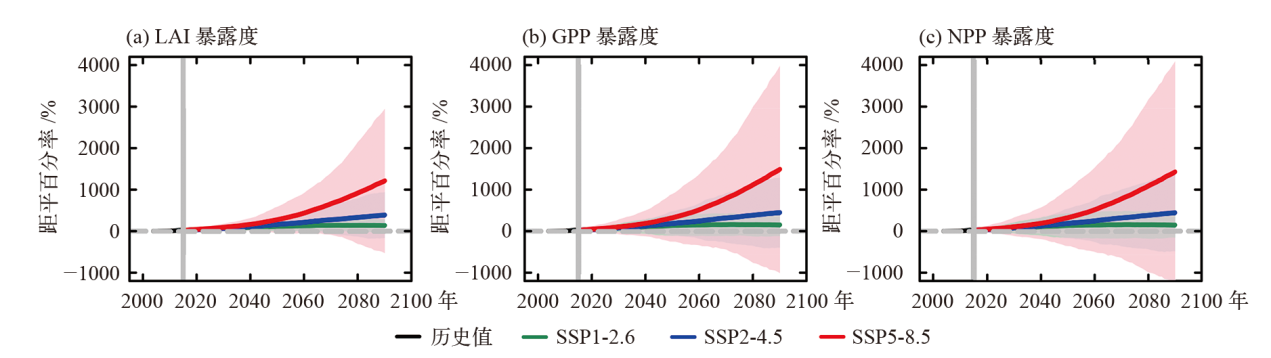
Fig. 7 Temporal changes in percentage anomalies of LAI exposure (a), GPP exposure (b), and NPP exposure (c) averaged over mid-high latitude Asia under three scenarios. (Time series are smoothed with a 20-year running mean filter, and shadings represent the ranges of two standard deviations of model simulations)
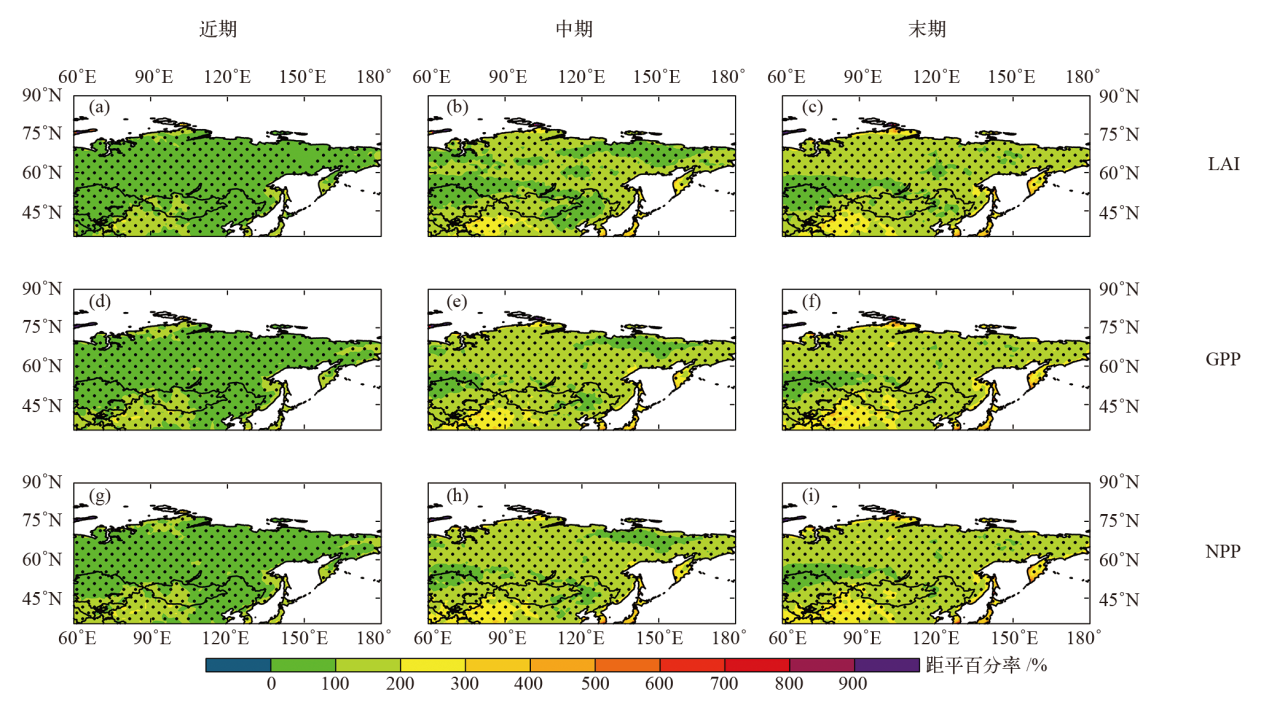
Fig. 8 Spatial distribution of the MME projected percentage anomalies of LAI exposure, GPP exposure, and NPP exposure during 2021-2040, 2041-2060, and 2081-2100 under SSP1-2.6. (Areas with the changes above the 0.05 significance level are dotted)
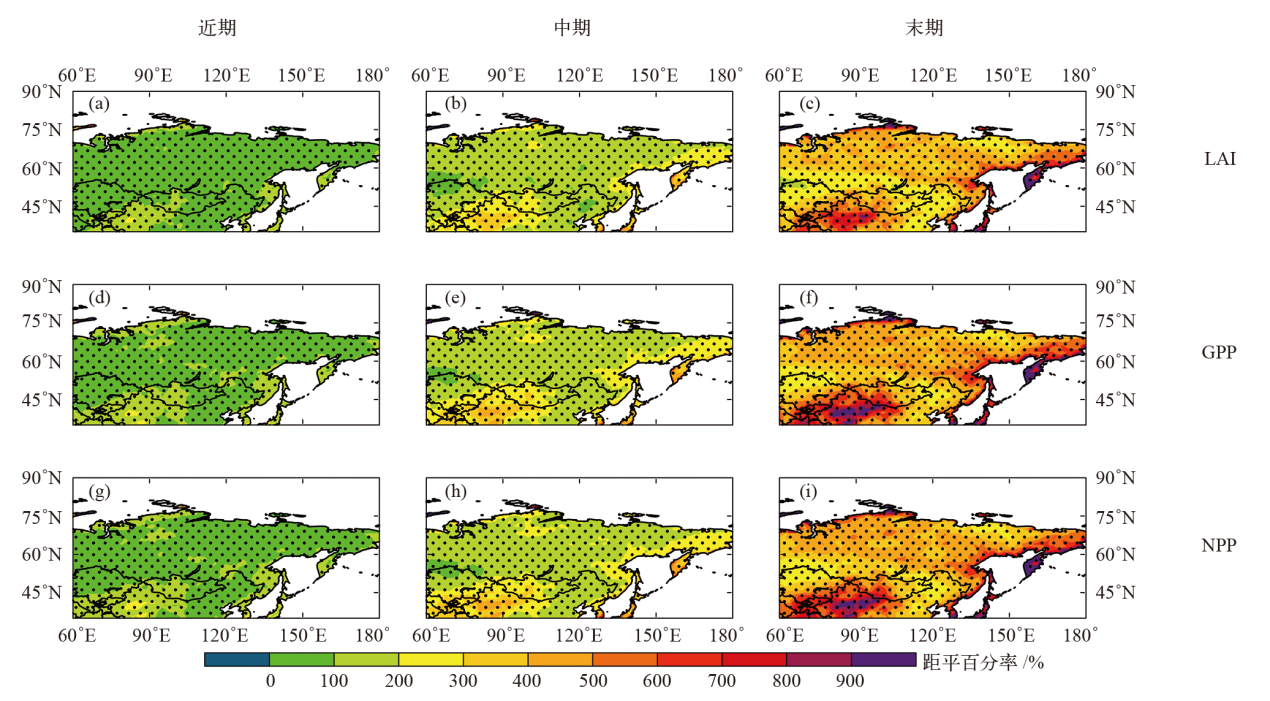
Fig. 9 Same as Fig. 8, but under SSP2-4.5

Fig. 10 Same as Fig. 8, but under SSP5-8.5
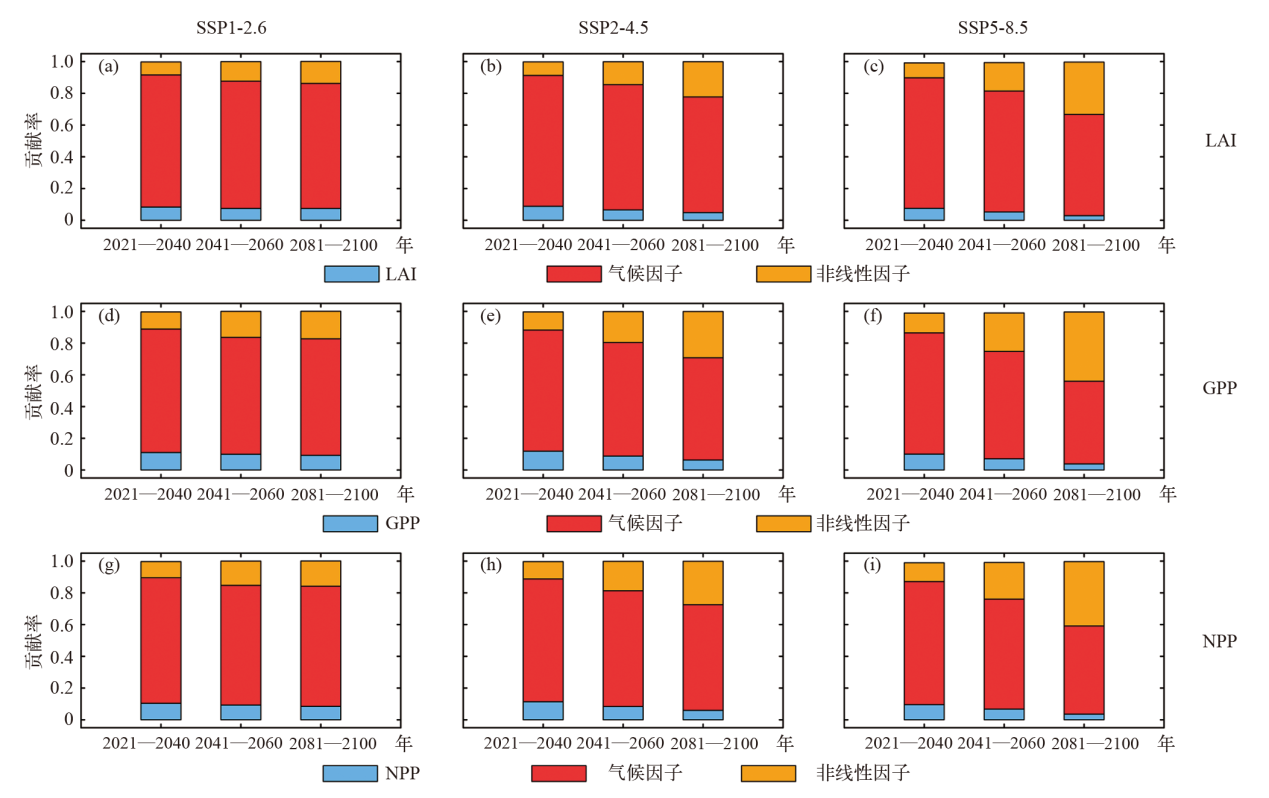
Fig. 11 Contribution of climate factor, nonlinear interaction, and ecological factor to projected changes in LAI exposure, GPP exposure, and NPP exposure averaged over mid-high latitude Asia during 2021-2040, 2041-2060, and 2081-2100 under three scenarios
| [1] | Han Q M, Sun S, Liu Z, et al. Accelerated exacerbation of global extreme heatwaves under warming scenarios[J]. International Journal of Climatology, 2022, 42 (11): 5430-5441 |
| [2] | IPCC. Climate change 2021: the physical science basis[M]. Cambridge: Cambridge University Press, 2021 |
| [3] | Dosio A. Projection of temperature and heat waves for Africa with an ensemble of CORDEX Regional Climate Models[J]. Climate Dynamics, 2017, 49 (1-2): 493-519 |
| [4] |
Sun Q H, Miao C Y, Hanel M, et al. Global heat stress on health, wildfires, and agricultural crops under different levels of climate warming[J]. Environment International, 2019, 128: 125-136
doi: S0160-4120(18)32865-4 pmid: 31048130 |
| [5] | Chapin F S, Randerson J T, McGuire A D, et al. Changing feedbacks in the climate-biosphere system[J]. Frontiers in Ecology and the Environment, 2008, 6 (6): 313-320 |
| [6] |
Frank D, Reichstein M, Bahn M, et al. Effects of climate extremes on the terrestrial carbon cycle: concepts, processes and potential future impacts[J]. Global Change Biology, 2015, 21 (8): 2861-2880
doi: 10.1111/gcb.12916 pmid: 25752680 |
| [7] | Erol A, Ekinci K, Akbolat D, et al. Modeling impacts of land uses on carbon and nitrogen contents, carbon dioxide and water effluxes of Mediterranean soils[J]. Polish Journal of Environmental Studies, 2016, 25 (4): 1479-1487 |
| [8] | 张嘉仪, 钱诚. 1960—2018年中国高温热浪的线性趋势分析方法与变化趋势[J]. 气候与环境研究, 2020, 25 (3): 225-239. |
| Zhang J Y, Qian C. Linear trend in occurrence of high temperature and heat waves in China for the 1960-2018 period: method and analysis results[J]. Climatic and Environmental Research, 2020, 25 (3): 225-239 (in Chinese) | |
| [9] | Yuan W P, Cai W W, Chen Y, et al. Severe summer heatwave and drought strongly reduced carbon uptake in Southern China[J]. Scientific Reports, 2016, 6 (1): 18813 |
| [10] | Zhang F W, Cao G M. Resilience of energy and CO2 exchange to a summer heatwave in an alpine humid grassland on the Qinghai-Tibetan Plateau[J]. Polish Journal of Environmental Studies, 2017, 26 (1): 385-394 |
| [11] |
Brilli F, Hörtnagl L J, Hammerle A, et al. Leaf and ecosystem response to soil water availability in mountain grasslands[J]. Agricultural and Forest Meteorology, 2011, 151 (12): 1731-1740
pmid: 24465071 |
| [12] | De Boeck H J, Dreesen F E, Janssens I A, et al. Climatic characteristics of heat waves and their simulation in plant experiments[J]. Global Change Biology, 2010, 16 (7): 1992-2000 |
| [13] | Hoover D L, Knapp A K, Smith M D. Resistance and resilience of a grassland ecosystem to climate extremes[J]. Ecology, 2014, 95 (9): 2646-2656 |
| [14] | Von Buttlar J, Zscheischler J, Rammig A, et al. Impacts of droughts and extreme-temperature events on gross primary production and ecosystem respiration: a systematic assessment across ecosystems and climate zones[J]. Biogeosciences, 2018, 15 (5): 1293-1318 |
| [15] | Pan Y D, Birdsey R A, Fang J Y, et al. A large and persistent carbon sink in the world’s forests[J]. Science, 2011, 333 (6045): 988-993 |
| [16] | Schuur E A G, McGuire A D, Schadel C, et al. Climate change and the permafrost carbon feedback[J]. Nature, 2015, 520 (7546): 171-179 |
| [17] | Gang C C, Zhang Y Z, Wang Z Q, et al. Modeling the dynamics of distribution, extent, and NPP of global terrestrial ecosystems in response to future climate change[J]. Global and Planetary Change, 2017, 148 (G1): 153-165 |
| [18] |
Lucht W, Prentice I C, Myneni R B, et al. Climatic control of the high-latitude vegetation greening trend and Pinatubo effect to cite this version: HAL Id: hal-01757611 climatic control of the high-latitude vegetation greening trend and pinatubo effect[J]. Science, 2002, 296 (5573): 1687-1689
pmid: 12040194 |
| [19] |
Perkins-Kirkpatrick S E, Lewis S C. Increasing trends in regional heatwaves[J]. Nature Communications, 2020, 11 (1): 3357
doi: 10.1038/s41467-020-16970-7 pmid: 32620857 |
| [20] | Xin N, Zhou B T, Chen H S, et al. Variability of spring ecosystem water use efficiency in Northeast Asia and its linkage to the Polar-Eurasia pattern[J]. Environmental Research Letters, 2023, 18 (9): 094055 |
| [21] |
Nemani R R, Keeling C D, Hashimoto H, et al. Climate-driven increases in global terrestrial net primary production from 1982 to 1999[J]. Science, 2003, 300 (5625): 1560-1563
pmid: 12791990 |
| [22] |
Zhu Z C, Piao S L, Myneni R B, et al. Greening of the Earth and its drivers[J]. Nature Climate Change, 2016, 6 (8): 791-795
doi: 10.1038/NCLIMATE3004 |
| [23] | 孙晓玲, 谢文欣, 周波涛. CMIP6模式对亚洲陆地生态系统的模拟评估与预估[J]. 气候变化研究进展, 2023, 19 (1): 49-62. |
| Sun X L, Xie W X, Zhou B T. CMIP6 evaluation and projection of terrestrial ecosystem over Asia[J]. Climate Change Research, 2023, 19 (1): 49-62 (in Chinese) | |
| [24] | Park S B, Park C E, Kim J S, et al. The 2020 heatwave led to a larger enhancement in annual gross primary production in West Siberia than in East Siberia[J]. Journal of Geophysical Research: Biogeosciences, 2025, 130 (2): e2024JG008487 |
| [25] | Trenberth K E, Fasullo J T. Climate extremes and climate change: the Russian heat wave and other climate extremes of 2010[J]. Journal of Geophysical Research: Atmospheres, 2012, 117 (D17): D17103 |
| [26] | Bastos A, Gouveia C M, Trigo R M, et al. Analysing the spatio-temporal impacts of the 2003 and 2010 extreme heatwaves on plant productivity in Europe[J]. Biogeosciences, 2014, 11 (13): 3421-3435 |
| [27] | Smith M D. An ecological perspective on extreme climatic events: a synthetic definition and framework to guide future research[J]. Journal of Ecology, 2011, 99 (3): 656-663 |
| [28] | 尹姗, 孙诚, 李建平. 灾害风险的决定因素及其管理[J]. 气候变化研究进展, 2012, 8 (2): 84-89. |
| Yin S, Sun C, Li J P. Determinants of disaster risk and disaster risk management[J]. Climate Change Research, 2012, 8 (2): 84-89 (in Chinese) | |
| [29] | Li Z S, Guo X L, Yang Y, et al. Heatwave trends and the population exposure over China in the 21st century aswell as under 1.5℃ and 2.0℃ global warmer future scenarios[J]. Sustainability, 2019, 11 (12): 3318 |
| [30] | 吕嫣冉, 姜彤, 陶辉, 等. “一带一路”区域极端高温事件与人口暴露度特征[J]. 科技导报, 2020, 38 (16): 68-79. |
| Lyu Y R, Jiang T, Tao H, et al. Spatial-temporal patterns of population exposed to the extreme maximum temperature events in the Belt and Road regions[J]. Science & Technology Review, 2020, 38 (16): 68-79 (in Chinese) | |
| [31] | 张丽霞, 陈晓龙, 辛晓歌. CMIP6情景模式比较计划(ScenarioMIP)概况与评述[J]. 气候变化研究进展, 2019, 15 (5): 519-525. |
| Zhang L X, Chen X L, Xin X G. Short commentary on CMIP6 Scenario Model Intercomparison Project (ScenarioMIP)[J]. Climate Change Research, 2019, 15 (5): 519-525 (in Chinese) | |
| [32] | Fang H L, Baret F, Plummer S, et al. An overview of global leaf area index (LAI): methods, products, validation, and applications[J]. Reviews of Geophysics, 2019, 57 (3): 739-799 |
| [33] | 方精云, 柯金虎, 唐志尧, 等. 生物生产力的“4P”概念、估算及其相互关系[J]. 植物生态学报, 2001, 25 (4): 414-419. |
| Fang J Y, Ke J H, Tang Z R, et al. Implications and estimations of four terrestrial productivity parameters[J]. Chinese Journal of Plant Ecology, 2001, 25 (4): 414-419 (in Chinese) | |
| [34] | Peng X B, Yu M, Chen H S. Projected changes in terrestrial vegetation and carbon fluxes under 1.5℃ and 2.0℃ global warming[J]. Atmosphere, 2022, 13 (1): 42 |
| [35] | Li W P, Zhang Y W, Shi X L, et al. Development of land surface model BCC_AVIM2.0 and its preliminary performance in LS3MIP/CMIP6[J]. Journal of Meteorological Research, 2019, 33 (5): 851-869 |
| [36] |
Swart N C, Cole J N S, Kharin V V, et al. The Canadian Earth System Model version 5 (CanESM5.0.3)[J]. Geoscientific Model Development, 2019, 12 (11): 4823-4873
doi: 10.5194/gmd-12-4823-2019 |
| [37] | Wyser K, Van Noije T, Yang S T, et al. On the increased climate sensitivity in the EC-Earth model from CMIP5 to CMIP6[J]. Geoscientific Model Development, 2020, 13 (8): 3465-3474 |
| [38] | Volodin E M, Mortikov E V, Kostrykin S V, et al. Simulation of the modern climate using the INM-CM48 climate model[J]. Russian Journal of Numerical Analysis and Mathematical Modelling, 2018, 33 (6): 367-374 |
| [39] | Lurton T, Balkanski Y, Bastrikov V, et al. Implementation of the CMIP6 forcing data in the IPSL-CM6A-LR model[J]. Journal of Advances in Modeling Earth Systems, 2020, 12 (4): e2019MS001940 |
| [40] |
Mauritsen T, Bader J, Becker T, et al. Developments in the MPI-M Earth System Model version 1.2 (MPI-ESM1.2) and its response to increasing CO2[J]. Journal of Advances in Modeling Earth Systems, 2019, 11 (4): 998-1038
doi: 10.1029/2018MS001400 pmid: 32742553 |
| [41] | Russo S, Sillmann J, Fischer E M. Top ten European heatwaves since 1950 and their occurrence in the coming decades[J]. Environmental Research Letters, 2015, 10 (12): 124003 |
| [42] | Taylor K E. Summarizing multiple aspects of model performance in a single diagram[J]. Journal of Geophysical Research: Atmospheres, 2001, 106 (D7): 7183-7192 |
| [43] | 蒋文好, 陈活泼. CMIP6模式对亚洲中高纬区极端温度变化的模拟及预估[J]. 大气科学学报, 2021, 44 (4): 592-603. |
| Jiang W H, Chen H P. Assessment and projection of changes in temperature extremes over the mid-high latitudes of Asia based on CMIP6 models[J]. Transactions of Atmospheric Sciences, 2021, 44 (4): 592-603 (in Chinese) | |
| [44] | Yan M C, Yue X, Zhou B T, et al. Projected changes of ecosystem productivity and their responses to extreme heat events in northern Asia[J]. Frontiers in Earth Science, 2022, 10: 970296 |
| [45] |
Niu S L, Luo Y Q, Fei S F, et al. Thermal optimality of net ecosystem exchange of carbon dioxide and underlying mechanisms[J]. New Phytologist, 2012, 194 (3): 775-783
doi: 10.1111/j.1469-8137.2012.04095.x pmid: 22404566 |
| [46] |
De Boeck H J, Dreesen F E, Janssens I A, et al. Whole-system responses of experimental plant communities to climate extremes imposed in different seasons[J]. New Phytologist, 2011, 189 (3): 806-817
doi: 10.1111/j.1469-8137.2010.03515.x pmid: 21054412 |
| [47] | Buermann W, Bikash P R, Jung M, et al. Earlier springs decrease peak summer productivity in North American boreal forests[J]. Environmental Research Letters, 2013, 8 (2): 024027 |
| [1] | ZHOU Tian-Jun, CHEN Zi-Ming, CHEN Xiao-Long, ZUO Meng, JIANG Jie, HU Shuai. Interpreting IPCC AR6: future global climate based on projection under scenarios and on near-term information [J]. Climate Change Research, 2021, 17(6): 652-663. |
| [2] | CHEN Xi, LI Ning, ZHANG Zheng-Tao, LIU Jia-Wei, WANG Fang. Estimation of future global population exposure to heatwaves—based on the heat stress index [J]. Climate Change Research, 2020, 16(4): 424-432. |
| Viewed | ||||||
|
Full text |
|
|||||
|
Abstract |
|
|||||