气候变化研究进展 ›› 2025, Vol. 21 ›› Issue (2): 169-185.doi: 10.12006/j.issn.1673-1719.2024.205
能量收支框架下从辐射强迫-气候反馈到气候敏感度的研究进展
于晓超1, 张华1( ), 王秋艳2, 赵树云3, 王菲4, 柳丽婷1, 刘梦婷1,5, 马馨宇1,3, 杨冬冬6, 李帅7
- 1 中国气象科学研究院灾害天气国家重点实验室,北京 100081
2 近地面探测技术重点实验室,无锡 214035
3 中国地质大学(武汉)环境学院,武汉 430078
4 安徽省公共气象服务中心,合肥 230031
5 复旦大学大气与海洋科学系,上海 200438
6 曲阜师范大学地理与旅游学院,日照 276826
7 东华大学环境科学与工程学院,上海 201620
-
收稿日期:2024-08-01修回日期:2024-10-18出版日期:2025-03-30发布日期:2025-02-27 -
通讯作者:张华,女,研究员,huazhang@cma.gov.cn -
作者简介:于晓超,男,助理研究员 -
基金资助:国家自然基金面上和重点基金项目(42275039);国家自然基金面上和重点基金项目(U2342224);国家重点研发计划项目(2017YFA0603502);国家重点研发计划项目(2022YFC3701202);中国气象科学研究院科技发展基金(2024KJ021)
Advancements in the understanding of radiative forcing, climate feedback, and climate sensitivity within the energy budget framework
YU Xiao-Chao1, ZHANG Hua1(), WANG Qiu-Yan2, ZHAO Shu-Yun3, WANG Fei4, LIU Li-Ting1, LIU Meng-Ting1,5, MA Xin-Yu1,3, YANG Dong-Dong6, LI Shuai7
- 1 State Key Laboratory of Severe Weather, Chinese Academy of Meteorological Sciences, Beijing 100081, China
2 Science and Technology on Near-Surface Detection Laboratory, Wuxi 214035, China
3 School of Environmental Studies, China University of Geosciences, Wuhan 430078, China
4 Anhui Public Meteorological Service Center, Hefei 230031, China
5 Department of Atmospheric and Oceanic Sciences & Institute of Atmospheric Sciences, Fudan University, Shanghai 200438, China
6 School of Geography and Tourism, Qufu Normal University, Rizhao 276826, China
7 College of Environmental Science and Engineering, Donghua University, Shanghai 201620, China
-
Received:2024-08-01Revised:2024-10-18Online:2025-03-30Published:2025-02-27

摘要:
从能量框架出发,对地球能量收支、有效辐射强迫、气候反馈和气候敏感度的相关研究做出系统的梳理。自20世纪80年代以来,地球能量收支增加0.28~0.52 W/m2,主要来源于大气顶反射太阳辐射持续减少,这是该时期全球升温的重要决定性因素。这些能量收支的改变与人为强迫及其气候影响密切相关。政府间气候变化专门委员会(IPCC)第六次评估报告(AR6)指出,1750—2019年,总的人为有效辐射强迫的最佳估计为(2.72±0.76)W/m2,引起的全球地表温度变化预计可达1.29(1.00~1.65)℃。气候反馈总体上能够抵消辐射强迫对地球系统的整体扰动,使气候状态趋于稳定。IPCC AR6给出的净反馈最佳估计结果为-1.16(-1.81~-0.51)W/(m2·℃)。为了预估未来气候变化,IPCC AR6给出了平衡态气候敏感度和瞬态气候响应的最佳估计值,分别为3.0(2.0~5.0)℃和1.8(1.2~2.4)℃。依据能量收支平衡下强迫-反馈理论框架,科学界通过量化地球能量收支及其长期变化、区分辐射强迫与气候反馈,厘清了人为和自然等外部强迫对气候变化的影响;依据气候反馈参数和气候敏感度的估算结果,可量化气候对强迫的响应幅度,实现对未来气候的合理预估。
引用本文
于晓超, 张华, 王秋艳, 赵树云, 王菲, 柳丽婷, 刘梦婷, 马馨宇, 杨冬冬, 李帅. 能量收支框架下从辐射强迫-气候反馈到气候敏感度的研究进展[J]. 气候变化研究进展, 2025, 21(2): 169-185.
YU Xiao-Chao, ZHANG Hua, WANG Qiu-Yan, ZHAO Shu-Yun, WANG Fei, LIU Li-Ting, LIU Meng-Ting, MA Xin-Yu, YANG Dong-Dong, LI Shuai. Advancements in the understanding of radiative forcing, climate feedback, and climate sensitivity within the energy budget framework[J]. Climate Change Research, 2025, 21(2): 169-185.
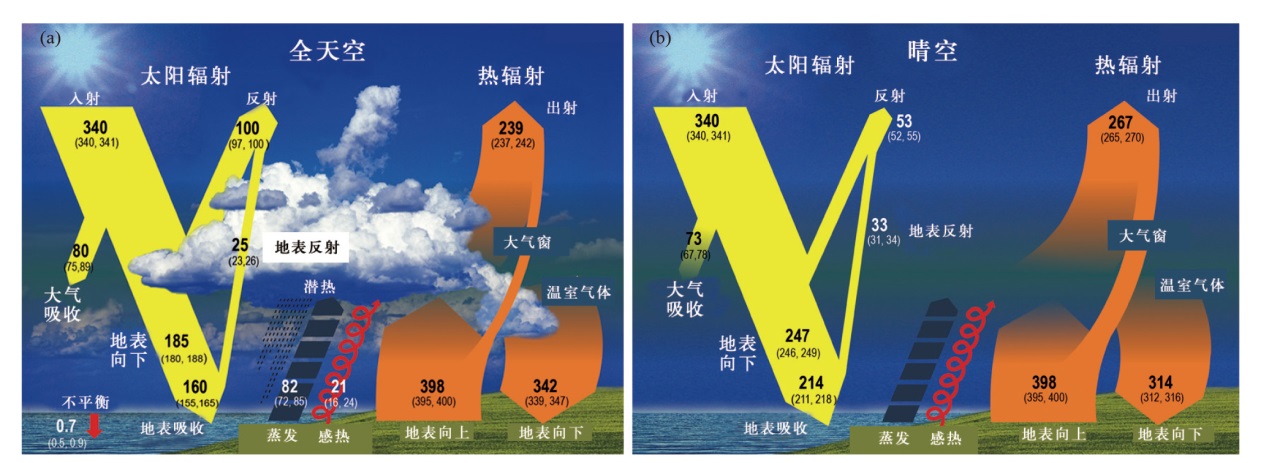
图1 当前全球平均能量收支示意图(a)以及不考虑云效应的等效图(b)
Fig. 1 Diagram of the current global average energy balance (a) and the equivalent diagram without considering cloud effects (b)
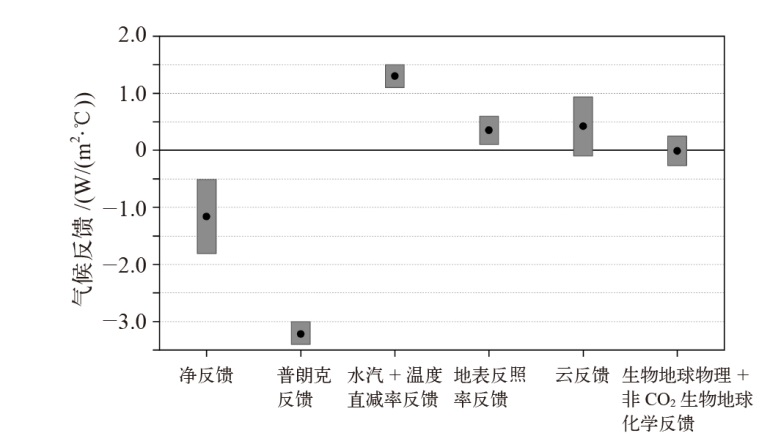
图2 全球平均气候反馈 注:此图改绘自IPCC AR6第7章 图7.10。圆形表示最佳估计值,箱体表示5%~95%置信区间。
Fig. 2 Global mean climate feedback
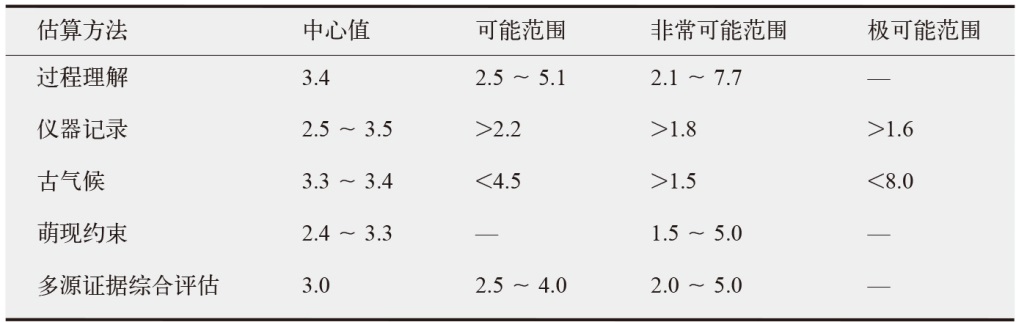 |
表1 基于多源证据的气候敏感度(ECS)估计[6]
Table 1 Estimates of equilibrium climate sensitivity (ECS) based on multiple lines of evidence[6]℃
| |
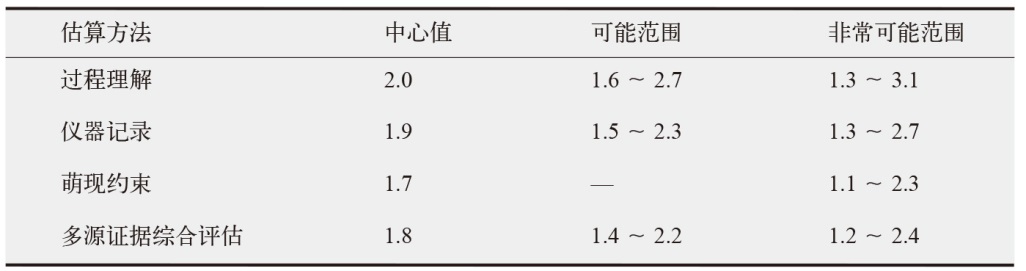 |
表2 基于多源证据的瞬态气候响应(TCR)估计[6]
Table 2 Estimates of transient climate response (TCR) based on multiple lines of evidence[6] ℃
| |
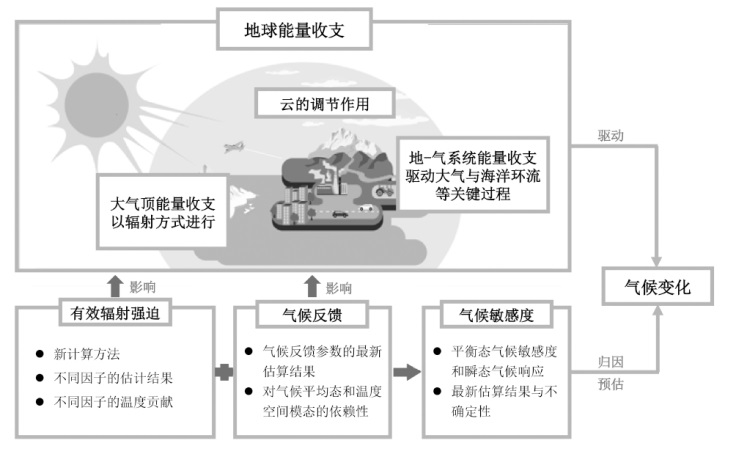
图3 能量收支平衡下强迫-反馈理论框架及最新进展的概念图 注:此图改绘自IPCC AR6第7章 图7.1。
Fig. 3 Diagram of the forcing-feedback framework in the context of energy balance and its latest advances
| [1] | 周天军, 张文霞, 陈德亮, 等. 2021年诺贝尔物理学奖解读: 从温室效应到地球系统科学[J]. 中国科学: 地球科学, 2022, 52 (4): 579-594. |
| Zhou T J, Zhang W X, Chen D L, et al. Understanding and building upon the pioneering work of Nobel Prize in Physics 2021 laureates Syukuro Manabe and Klaus Hasselmann: from the greenhouse effect to Earth system science and beyond[J]. Science China Earth Sciences, 2022, 65 (4): 589-600 (in Chinese) | |
| [2] | 徐影, 韩振宇, 吴婕, 等. 低排放情景下全球极端气候事件变化在温升过冲前后达到1.5℃的差异[J]. 气候变化研究进展, 2024, 20 (4): 389-402. |
| Xu Y, Han Z Y, Wu J, et al. The differences of global extreme climate events change before and after 1.5℃ overshoot[J]. Climate Change Research, 2024, 20 (4): 389-402 (in Chinese) | |
| [3] | 张华, 王菲, 赵树云, 等. IPCC AR6报告解读: 地球能量收支、气候反馈和气候敏感度[J]. 气候变化研究进展, 2021, 17 (6): 691-698. |
| Zhang H, Wang F, Zhao S Y, et al. Earth’s energy budget, climate feedbacks, and climate sensitivity[J]. Climate Change Research, 2021, 17 (6): 691-698 (in Chinese) | |
| [4] | 赵树云, 孔铃涵, 张华, 等. IPCC AR6对地球气候系统中反馈机制的新认识[J]. 大气科学学报, 2021, 44 (6): 805-817. |
| Zhao S Y, Kong L H, Zhang H, et al. New understanding of the feedback mechanisms in the Earth climate system in IPCC AR6[J]. Transactions of Atmospheric Sciences, 2021, 44 (6): 805-817 (in Chinese) | |
| [5] | 赵树云, 袁畅, 张华, 等. 基于多源证据估算气候敏感度最新研究进展: IPCC AR6解读[J]. 大气科学学报, 2023, 46 (6): 848-863. |
| Zhao S Y, Yuan C, Zhang H, et al. Advances in the assessment of climate sensitivity based on multi-source evidence: interpreting IPCC AR6[J]. Transactions of Atmospheric Sciences, 2023, 46 (6): 848-863 (in Chinese) | |
| [6] | IPCC. Climate change 2021: the physical science basis[M]. Cambridge: Cambridge University Press, 2021 |
| [7] | Samset B H, Myhre G, Forster P M, et al. Fast and slow precipitation responses to individual climate forcers: a PDRMIP multimodel study[J]. Geophysical Research Letters, 2016, 43: 2783-2791 |
| [8] | 谢冰, 张华, 赵树云, 等. 有效辐射强迫的概念及其最新估值: IPCC AR6解读[J]. 大气科学学报, 2023, 46 (3): 354-368. |
| Xie B, Zhang H, Zhao S Y, et al. The concept of effective radiative forcing and the latest estimations: interpreting IPCC AR6[J]. Transactions of Atmospheric Sciences, 2023, 46 (3): 354-368 (in Chinese) | |
| [9] | 张华, 王菲, 汪方, 等. 全球气候变化中的云辐射反馈作用研究进展[J]. 中国科学: 地球科学, 2022, 52 (3): 400-417. |
| Zhang H, Wang F, Wang F, et al. Advances in cloud radiative feedbacks in global climate change[J]. Scientia Sinica Terrae, 2022, 52 (3): 400-417 (in Chinese) | |
| [10] | 张华, 杨镇江, 苏红娟, 等. 短寿命气候强迫因子的自然源排放及气候反馈: IPCC AR6解读[J]. 大气科学学报, 2023, 46 (4): 491-498. |
| Zhang H, Yang Z J, Su H J, et al. Natural emissions of short-lived climate forcers and their climate feedbacks: IPCC AR6 interpretion[J]. Transactions of Atmospheric Sciences, 2023, 46 (4): 491-498 (in Chinese) | |
| [11] | 王菲, 张华, 刘梦婷, 等. 气候反馈对空间模态的依赖性: IPCC AR6解读[J]. 大气科学学报, 2022, 45 (6): 826-834. |
| Wang F, Zhang H, Liu M T, et al. Dependence of climate feedbacks on temperature patterns: interpreting IPCC AR6[J]. Transactions of Atmospheric Sciences, 2022, 45 (6): 826-834 (in Chinese) | |
| [12] | 周天军, 陈晓龙, 左萌, 等. 地球气候敏感度研究的现状和未来[J]. 第四纪研究, 2023, 43 (2): 604-624. |
| Zhou T J, Chen X L, Zuo M, et al. Earth’s climate sensitivity: methods, climate feedback processes, progresses and prospects[J]. Quaternary Sciences, 2023, 43 (2): 604-624 (in Chinese) | |
| [13] |
Wild M, Hakuba M Z, Folini D, et al. The cloud-free global energy balance and inferred cloud radiative effects: an assessment based on direct observations and climate models[J]. Climate Dynamics, 2019, 52: 4787-4812
doi: 10.1007/s00382-018-4413-y pmid: 30996525 |
| [14] | Loeb N G, Wang H L, Allan R P, et al. New generation of climate models track recent unprecedented changes in Earth’s radiation budget observed by CERES[J]. Geophysical Research Letters, 2020, 47 (5): e2019GL086705 |
| [15] |
Allan R P, Liu C L, Loeb N G, et al. Changes in global net radiative imbalance 1985-2012[J]. Geophysical Research Letters, 2014, 41 (15): 5588-5597
pmid: 25821270 |
| [16] | Liu C L, Allan R P, Mayer M, et al. Variability in the global energy budget and transports 1985-2017[J]. Climate Dynamics, 2020, 55: 3381-3396 |
| [17] | Johnson G C, Lyman J M, Loeb N G. Improving estimates of Earth’s energy imbalance[J]. Nature Climate Change, 2016, 6 (7): 639-640 |
| [18] | Meyssignac B, Boyer T, Zhao Z X, et al. Measuring global ocean heat content to estimate the Earth energy imbalance[J]. Frontiers in Marine Science, 2019, 6: 432 |
| [19] | Loeb N G, Doelling D R, Wang H L, et al. Clouds and the Earth’s radiant energy system (CERES) energy balanced and filled (EBAF) top-of-atmosphere (TOA) edition-4.0 data product[J]. Journal of Climate, 2018, 31 (2): 895-918 |
| [20] | Raghuraman S P, Paynter D, Ramaswamy V. Quantifying the drivers of the clear sky greenhouse effect, 2000-2016[J]. Journal of Geophysical Research: Atmospheres, 2019, 124 (21): 11354-11371 |
| [21] | Loeb N G, Thorsen T J, Norris J R, et al. Changes in Earth’s energy budget during and after the “pause” in global warming: an observational perspective[J]. Climate, 2018, 6 (3): 62 |
| [22] | Paulot F, Paynter D, Ginoux P, et al. Changes in the aerosol direct radiative forcing from 2001 to 2015: observational constraints and regional mechanisms[J]. Atmospheric Chemistry and Physics, 2018, 18 (17): 13265-13281 |
| [23] | Elagib N A, Alvi S H. Moderate solar dimming in an accelerating warming climate of Bahrain[J]. International Journal of Global Warming, 2013, 5 (1): 96-107 |
| [24] | You Q L, Sanchez-Lorenzo A, Wild M, et al. Decadal variation of surface solar radiation in the Tibetan Plateau from observations, reanalysis and model simulations[J]. Climate Dynamics, 2013, 40: 2073-2086 |
| [25] | García R D, Cuevas E, García O E, et al. Reconstruction of global solar radiation time series from 1933 to 2013 at the Izaña atmospheric observatory[J]. Atmospheric Measurement Techniques, 2014, 7 (9): 3139-3150 |
| [26] | Longman R J, Giambelluca T W, Alliss R J, et al. Temporal solar radiation change at high elevations in Hawai’i[J]. Journal of Geophysical Research: Atmospheres, 2014, 119 (10): 6022-6033 |
| [27] | Rahimzadeh F, Sanchez-Lorenzo A, Hamedi M, et al. New evidence on the dimming/brightening phenomenon and decreasing diurnal temperature range in Iran (1961-2009)[J]. International Journal of Climatology, 2015, 35 (8): 2065-2079 |
| [28] | Manara V, Brunetti M, Celozzi A, et al. Detection of dimming/brightening in Italy from homogenized all-sky and clear-sky surface solar radiation records and underlying causes (1959-2013)[J]. Atmospheric Chemistry and Physics, 2016, 16 (17): 11145-11161 |
| [29] | Soni V K, Pandithurai G, Pai D S. Is there a transition of solar radiation from dimming to brightening over India?[J]. Atmospheric Research, 2016, 169: 209-224 |
| [30] | Wang Y W, Wild M. A new look at solar dimming and brightening in China[J]. Geophysical Research Letters, 2016, 43 (22): 11777-11785 |
| [31] | Jahani B, Dinpashoh Y, Wild M. Dimming in Iran since the 2000s and the potential underlying causes[J]. International Journal of Climatology, 2018, 38 (3): 1543-1559 |
| [32] | Pfeifroth U, Sanchez-Lorenzo A, Manara V, et al. Trends and variability of surface solar radiation in Europe based on surface- and satellite-based data records[J]. Journal of Geophysical Research: Atmospheres, 2018, 123 (3): 1735-1754 |
| [33] | Yang S, Wang X L, Wild M. Homogenization and trend analysis of the 1958-2016 in situ surface solar radiation records in China[J]. Journal of Climate, 2018, 31 (11): 4529-4541 |
| [34] | Schwarz M, Folini D, Yang S, et al. Changes in atmospheric shortwave absorption as important driver of dimming and brightening[J]. Nature Geoscience, 2020, 13 (2): 110-115 |
| [35] | Tanaka K, Ohmura A, Folini D, et al. Is global dimming and brightening in Japan limited to urban areas?[J]. Atmospheric Chemistry and Physics, 2016, 16 (21): 13969-14001 |
| [36] | Kazadzis S, Founda D, Psiloglou B E, et al. Long-term series and trends in surface solar radiation in Athens, Greece[J]. Atmospheric Chemistry and Physics, 2018, 18 (4): 2395-2411 |
| [37] |
Yang S, Wang X L, Wild M. Causes of dimming and brightening in China inferred from homogenized daily clear-sky and all-sky in situ surface solar radiation records (1958-2016)[J]. Journal of Climate, 2019, 32 (18): 5901-5913
doi: 10.1175/JCLI-D-18-0666.1 |
| [38] | Wild M, Wacker S, Yang S, et al. Evidence for clear-sky dimming and brightening in Central Europe[J]. Geophysical Research Letters, 2021, 48 (6): e2020GL092216 |
| [39] | Imamovic A, Tanaka K, Folini D, et al. Global dimming and urbanization: did stronger negative SSR trends collocate with regions of population growth?[J]. Atmospheric Chemistry and Physics, 2016, 16 (5): 2719-2725 |
| [40] | Wild M. Global dimming and brightening: a review[J]. Journal of Geophysical Research: Atmospheres, 2009, 114 (D10). DOI: 10.1029/2008JD011470 |
| [41] | Mateos D, Antón M, Sanchez-Lorenzo A, et al. Long-term changes in the radiative effects of aerosols and clouds in a mid-latitude region (1985-2010)[J]. Global and Planetary Change, 2013, 111: 288-295 |
| [42] | Posselt R, Mueller R, Trentrnann J, et al. A surface radiation climatology across two METEOSAT satellite generations[J]. Remote Sensing of Environment, 2014, 142: 103-110 |
| [43] | Golaz J C, Horowitz L W, Levy H. Cloud tuning in a coupled climate model: impact on 20th century warming[J]. Geophysical Research Letters, 2013, 40 (10): 2246-2251 |
| [44] | Nabat P, Somot S, Mallet M, et al. Contribution of anthropogenic sulfate aerosols to the changing Euro-Mediterranean climate since 1980[J]. Geophysical Research Letters, 2014, 41 (15): 5605-5611 |
| [45] | Turnock S T, Spracklen D V, Carslaw K S, et al. Modelled and observed changes in aerosols and surface solar radiation over Europe between 1960 and 2009[J]. Atmospheric Chemistry and Physics, 2015, 15 (16): 9477-9500 |
| [46] |
Moseid K O, Schulz M, Storelvmo T, et al. Bias in CMIP6 models compared to observed regional dimming and brightening trends (1961-2014)[J]. Atmospheric Chemistry and Physics, 2020, 20 (24): 16023-16040
doi: 10.5194/acp-20-16023-2020 |
| [47] | Streets D G, Wu Y, Chin M. Two-decadal aerosol trends as a likely explanation of the global dimming/brightening transition[J]. Geophysical Research Letters, 2006, 33 (15): L15806 |
| [48] | Wang Y W, Yang Y H. China’s dimming and brightening: evidence, causes and hydrological implications[J]. Annales Geophysicae, 2014, 32 (1): 41-55 |
| [49] |
Storelvmo T, Leirvik T, Lohmann U, et al. Disentangling greenhouse warming and aerosol cooling to reveal Earth’s climate sensitivity[J]. Nature Geoscience, 2016, 9 (4): 286-289
doi: 10.1038/NGEO2670 |
| [50] |
Kinne S. Aerosol radiative effects with MACv2[J]. Atmospheric Chemistry and Physics, 2019, 19 (16): 10919-10959
doi: 10.5194/acp-19-10919-2019 |
| [51] | Augustine J A, Dutton E G. Variability of the surface radiation budget over the United States from 1996 through 2011 from high-quality measurements[J]. Journal of Geophysical Research: Atmospheres, 2013, 118 (1): 43-53 |
| [52] | Parding K, Olseth J A, Dagestad K F, et al. Decadal variability of clouds, solar radiation and temperature at a high-latitude coastal site in Norway[J]. Tellus B: Chemical and Physical Meteorology, 2014, 66 (1): 25897 |
| [53] | Antuña-Marrero J C, García F, Estevan R, et al. Simultaneous dimming and brightening under all and clear sky at Camagüey, Cuba (1981-2010)[J]. Journal of Atmospheric and Solar: Terrestrial Physics, 2019, 190: 45-53 |
| [54] | Allen R J, Norris J R, Wild M. Evaluation of multidecadal variability in CMIP5 surface solar radiation and inferred underestimation of aerosol direct effects over Europe, China, Japan, and India[J]. Journal of Geophysical Research: Atmospheres, 2013, 118 (12): 6311-6336 |
| [55] | Storelvmo T, Heede U K, Leirvik T, et al. Lethargic response to aerosol emissions in current climate models[J]. Geophysical Research Letters, 2018, 45 (18): 9814-9823 |
| [56] | Wohland J, Brayshaw D, Bloomfield H, et al. European multidecadal solar variability badly captured in all centennial reanalyses except CERA20C[J]. Environmental Research Letters, 2020, 15 (10): 104021 |
| [57] | Feng F, Wang K C. Does the modern-era retrospective analysis for research and applications-2 aerosol reanalysis introduce an improvement in the simulation of surface solar radiation over China?[J]. International Journal of Climatology, 2019, 39 (3): 1305-1318 |
| [58] | Gulev S K, Belyaev K. Probability distribution characteristics for surface air-sea turbulent heat fluxes over the global ocean[J]. Journal of Climate, 2012, 25 (1): 184-206 |
| [59] | Mueller B, Hirschi M, Jimenez C, et al. Benchmark products for land evapotranspiration: LandFlux-EVAL multi-data set synthesis[J]. Hydrology and Earth System Sciences, 2013, 17 (10): 37073720 |
| [60] | Mallick K, Trebs I, Boegh E, et al. Canopy-scale biophysical controls of transpiration and evaporation in the Amazon Basin[J]. Hydrology and Earth System Sciences, 2016, 20 (10): 4237-4264 |
| [61] | Fisher J B, Melton F, Middleton E, et al. The future of evapotranspiration: global requirements for ecosystem functioning, carbon and climate feedbacks, agricultural management, and water resources[J]. Water Resources Research, 2017, 53 (4): 2618-2626 |
| [62] | McCabe M F, Aragon B, Houborg R, et al. CubeSats in hydrology: ultrahigh-resolution insights into vegetation dynamics and terrestrial evaporation[J]. Water Resources Research, 2017, 53 (12): 10017-10024 |
| [63] | Rodell M, Famiglietti J S, Wiese D N, et al. Emerging trends in global freshwater availability[J]. Nature, 2018, 557 (7707): 651-659 |
| [64] | Etminan M, Myhre G, Highwood E J, et al. Radiative forcing of carbon dioxide, methane, and nitrous oxide: a significant revision of the methane radiative forcing[J]. Geophysical Research Letters, 43 (24): 12, 614-623 |
| [65] | Meinshausen M, Nicholls Z R J, Lewis J, et al. The shared socio-economic pathway (SSP) greenhouse gas concentrations and their extensions to 2500[J]. Geoscientific Model Development, 13 (8): 3571-3605 |
| [66] | Hodnebrog Ø, Aamaas B, Fuglestved J F, et al. Updated global warming potentials and radiative efficiencies of halocarbons and other weak atmospheric absorbers[J]. Reviews of Geophysics, 2020, 58 (3): e2019RG000691 |
| [67] | Checa-Garcia R, Hegglin M I, Kinnison D, et al. Historical tropospheric and stratospheric ozone radiative forcing using the CMIP6 datebase[J]. Geophysical Research Letters, 45 (7): 3264-3273 |
| [68] | Skeie R B, Myhre G, Hodnebrog Ø, et al. Historical total ozone radiative forcing derived from CMIP6 simulations[J]. NPJ Climate and Atmospheric Science, 2020, 3 (1): 32 |
| [69] | Vial J, Dufresne J L, Bony S. On the interpretation of inter-model spread in CMIP5 climate sensitivity estimates[J]. Climate Dynamics, 2013, 41: 3339-3362 |
| [70] | Zhang M H, Huang Y. Radiative forcing of quadrupling CO2[J]. Journal of Climate, 2014, 27 (7): 2496-2508 |
| [71] |
Smith C J, Kramer R J, Myhre G, et al. Understanding rapid adjustments to diverse forcing agents[J]. Geophysical Research Letters, 2018, 45 (21): 12023-12031
doi: 10.1029/2018GL079826 pmid: 30686845 |
| [72] | Smith C J, Kramer R J, Myhre G, et al. Effective radiative forcing and adjustments in CMIP6 models[J]. Atmospheric Chemistry and Physics, 2020, 20 (16): 9591-9618 |
| [73] | Hodnebrog Ø, Myhre G, Kramer R J, et al. The effect of rapid adjustments to halocarbons and N2O on radiative forcing[J]. NPJ Climate and Atmospheric Science, 2020, 3 (1): 43 |
| [74] | Bellouin N, Mann G W, Woodhouse M T, et al. Impact of the modal aerosol scheme GLOMAP-mode on aerosol forcing in the Hadley Centre Global Environmental Model[J]. Atmospheric Chemistry and Physics, 2013, 13 (6): 3027-3044 |
| [75] | Ma X Y, Yu F Q, Quaas J. Reassessment of satellite-based estimate of aerosol climate forcing[J]. Journal of Geophysical Research: Atmospheres, 2014, 119 (17): 10394-10409 |
| [76] | Quaas J, Boucher O, Bellouin N, et al. Satellite-based estimate of the direct and indirect aerosol climate forcing[J]. Journal of Geophysical Research: Atmospheres, 2008, 113 (D5). DOI: 10.1029/2007JD008962 |
| [77] | Blunden J, Hartfield G, Arndt D S, et al. State of the climate in 2017[J]. Bulletin of the American Meteorological Society, 2018, 99 (8): 20-22 |
| [78] | Peng J F, Hu M, Guo S, et al. Markedly enhanced absorption and direct radiative forcing of black carbon under polluted urban environments[J]. Proceedings of the National Academy of Sciences, 2016, 113 (16): 4266-4271 |
| [79] | Wang R, Baklanski Y, Boucher O, et al. Estimation of global black carbon direct radiative forcing and its uncertainty constrained by observations[J]. Journal of Geophysical Research: Atmospheres, 2016, 121 (10): 5948-5971 |
| [80] |
Wang R, Andrews E, Balkanski Y, et al. Spatial representativeness error in the ground-level observation networks for black carbon radiation absorption[J]. Geophysical Research Letters, 2018, 45 (4): 2106-2114
doi: 10.1002/2017GL076817 pmid: 29937603 |
| [81] | Andrews E, Ogren J A, Kinne S, et al. Comparison of AOD, AAOD and column single scattering albedo from AERONET retrievals and in situ profiling measurements[J]. Atmospheric Chemistry and Physics, 2017, 17 (9): 6041-6072 |
| [82] | Lund M T, Samset B H, Skeie R B, et al. Short black carbon lifetime inferred from a global set of aircraft observations[J]. NPJ Climate and Atmospheric Science, 2018, 1 (1): 31 |
| [83] | Zanatta M, Gysel M, Bukowiecki N, et al. A European aerosol phenomenology-5: climatology of black carbon optical properties at 9 regional background sites across Europe[J]. Atmospheric Environment, 2016, 145: 346-364 |
| [84] | Stjern C W, Samset B H, Myhre G, et al. Rapid adjustments cause weak surface temperature response to increased black carbon concentrations[J]. Journal of Geophysical Research: Atmospheres, 2017, 122 (21): 11462-11481 |
| [85] | Allen R J, Amiri-Faranani A, Lamarque J F, et al. Observationally constrained aerosol-cloud semi-direct effects[J]. NPJ Climate and Atmospheric Science, 2019, 2 (1): 16 |
| [86] | Zhao S Y, Suzuki K. Differing impacts of black carbon and sulfate aerosols on global precipitation and the ITCZ location via atmosphere and ocean energy perturbations[J]. Journal of Climate, 2019, 32 (17): 5567-5582 |
| [87] | Smith C J, Kramer R J, Sima A. The HadGEM3-GA7.1 radiative kernel: the importance of a well-resolved stratosphere[J]. Earth System Science Data, 2020, 12 (3): 2157-2168 |
| [88] | Nakajima T, Higurashi A, Kawamoto K, et al. A possible correlation between satellite-derived cloud and aerosol microphysical parameters[J]. Geophysical Research Letters, 2001, 28 (7): 1171-1174 |
| [89] |
Kaufman Y J, Koren I. Smoke and pollution aerosol effect on cloud cover[J]. Science, 2006, 313 (5787): 655-658
pmid: 16840661 |
| [90] | Quaas J, Ming Y, Menon S, et al. Aerosol indirect effects: general circulation model intercomparison and evaluation with satellite data[J]. Atmospheric Chemistry and Physics, 2009, 9 (22): 8697-8717 |
| [91] | Christensen M W, Chen Y C, Stephens G L. Aerosol indirect effect dicated by liquid clouds[J]. Journal of Geophysical Research, 2016, 121 (24): 14636-14650 |
| [92] | Christensen M W, Neubauer D, Poulsen C A, et al. Unveiling aerosol-cloud interactions. Part 1: cloud contamination in satellite products enhances the aerosol indirect forcing estimate[J]. Atmospheric Chemistry and Physics, 2017, 17 (21): 13151-13164 |
| [93] | Gryspeerdt E, Quaas J, Bellouin N. Constraining the aerosol influence on cloud fraction[J]. Journal of Geophysical Research: Atmospheres, 2016, 121 (7): 3566-3583 |
| [94] | Rosenfeld D, Zhu Y N, Wang M H, et al. Aerosol-driven droplet concentrations dominate coverage and water of oceanic low level clouds[J]. Science, 2019, 363 (6427): eaav0566 |
| [95] | Michibata T, Suzuki K, Sato Y, et al. The source of discrepancies in aerosol-cloud-precipitation interactions between GCM and A-Train retrievals[J]. Atmospheric Chemistry and Physics, 2016, 16 (23): 15413-15424 |
| [96] |
Toll V, Christensen M, Gassó S, et al. Volcano and ship tracks indicate excessive aerosol-induced cloud water increases in a climate model[J]. Geophysical Research Letters, 2017, 44 (24): 12492-12500
doi: 10.1002/2017GL075280 pmid: 29713108 |
| [97] |
Gryspeerdt E, Goren T, Sourdeval O, et al. Constraining the aerosol influence on cloud liquid water path[J]. Atmospheric Chemistry and Physics, 2019, 19 (8): 5331-5347
doi: 10.5194/acp-19-5331-2019 |
| [98] |
Sato Y, Goto D, Michibata T, et al. Aerosol effects on cloud water amounts were successfully simulated by a global cloud-system resolving model[J]. Nature Communications, 2018, 9 (1): 985
doi: 10.1038/s41467-018-03379-6 pmid: 29515125 |
| [99] | Koren I, Kaufman Y J, Rosenfeld D, et al. Aerosol invigoration and restructuring of Atlantic convective clouds[J]. Geophysical Research Letters, 2005, 32 (14). DOI: 10.1029/2005GL023187 |
| [100] | Gryspeerdt E, Quaas J, Ferrachat S, et al. Constraining the instantaneous aerosol influence on cloud albedo[J]. Proceedings of the National Academy of Sciences, 2017, 114 (19): 4899-4904 |
| [101] | Hansen J, Lacis A, Rind D, et al. Climate sensitivity: analysis of feedback mechanisms[M]. Washington, DC: American Geophysical Union, 1984, 29: 130-163 |
| [102] | Cess R D, Potter G L, Blanchet J P, et al. Intercomparison and interpretation of climate feedback processes in 19 atmospheric general circulation models[J]. Journal of Geophysical Research: Atmospheres, 1990, 95 (D10): 16601-16615 |
| [103] | Gregory J M, Ingram W J, Palmer M A, et al. A new method for diagnosing radiative forcing and climate sensitivity[J]. Geophysical Research Letters, 2004, 31 (3): L03205 |
| [104] | Andrews T, Gregory J M, Webb M J, et al. Forcing, feedbacks and climate sensitivity in CMIP5 coupled atmosphere-ocean climate models[J]. Geophysical Research Letters, 2012, 39 (9): L09712 |
| [105] | Caldwell P M, Zelinka M D, Taylor K E, et al. Quantifying the sources of inter-model spread in equilibrium climate sensitivity[J]. Journal of Climate, 2016, 29 (2): 513-524 |
| [106] |
Rugenstein M, Bloch-Johnson J, Abe-Ouchi A, et al. LongRunMIP: motivation and design for a large collection of millennial-length AOGCM simulations[J]. Bulletin of the American Meteorological Society, 2019, 100 (12): 2551-2570
doi: 10.1175/BAMS-D-19-0068.1 |
| [107] | Hall A, Qu X. Using the current seasonal cycle to constrain snow albedo feedback in future climate change[J]. Geophysical Research Letters, 2006, 33 (3): L03502 |
| [108] | Klein S A, Hall A. Emergent constraints for cloud feedbacks[J]. Current Climate Change Reports, 2015, 1 (4): 276-287 |
| [109] | 周佰铨, 翟盘茂. IPCC第六次气候变化评估中的气候约束预估方法[J]. 气象学报, 2021, 79 (6): 1063-1070. |
| Zhou B Q, Zhai P M. The constraint methods for projection in the IPCC sixth assessment report on climate change[J]. Acta Meteorologica Sinica, 2021, 79 (6): 1063-1070 (in Chinese) | |
| [110] | Dessler A E. Observations of climate feedbacks over 2000-10 and comparisons to climate models[J]. Journal of Climate, 2013, 26 (1): 333-342 |
| [111] | Loeb N G, Wang H L, Cheng A N, et al. Observational constraints on atmospheric and oceanic cross-equatorial heat transports: revisiting the precipitation asymmetry problem in climate models[J]. Climate Dynamics, 2016, 46 (9): 3239-3257 |
| [112] | Zhou C, Zelinka M D, Dessler A E, et al. The relationship between interannual and long-term cloud feedbacks[J]. Geophysical Research Letters, 2015, 42 (23): 10463-10469 |
| [113] | Colman R, Hanson L. On the relative strength of radiative feedbacks under climate variability and change[J]. Climate Dynamics, 2017, 49 (5): 2115-2129 |
| [114] | Proistosescu C, Donohoe A, Armour K C, et al. Radiative feedbacks from stochastic variability in surface temperature and radiative imbalance[J]. Geophysical Research Letters, 2018, 45 (10): 5082-5094 |
| [115] | Meraner K, Mauritsen T, Voigt A. Robust increase in equilibrium climate sensitivity under global warming[J]. Geophysical Research Letters, 2013, 40 (22): 5944-5948 |
| [116] | Seeley J T, Jeevanjee N. H2O windows and CO2 radiator fins: a clear-sky explanation for the peak in equilibrium climate sensitivity[J]. Geophysical Research Letters, 2021, 48 (4): e2020GL089609 |
| [117] | Caballero R, Huber M. State-dependent climate sensitivity in past warm climates and its implications for future climate projections[J]. Proceedings of the National Academy of Sciences, 2013, 110 (35): 14162-14167 |
| [118] | Zhu J, Poulsen C J, Tierney J E. Simulation of Eocene extreme warmth and high climate sensitivity through cloud feedbacks[J]. Science Advances, 2019, 5 (9): eaax1874 |
| [119] | Rugenstein M, Bloch-Johnson J, Gregory J, et al. Equilibrium climate sensitivity estimated by equilibrating climate models[J]. Geophysical Research Letters, 2020, 47 (4): e2019GL083898 |
| [120] | Sherwood S C, Webb M J, Annan J D, et al. An assessment of Earth’s climate sensitivity using multiple lines of evidence[J]. Reviews of Geophysics, 2020, 58 (4): e2019RG000678 |
| [121] | Jonko A K, Shell K M, Sanderson B M, et al. Climate feedbacks in CCSM3 under changing CO2 forcing. Part II: variation of climate feedbacks and sensitivity with forcing[J]. Journal of Climate, 2013, 26 (9): 2784-2795 |
| [122] |
Mauritsen T, Bader J, Becker T, et al. Developments in the MPI-M Earth system model version 1.2 (MPI-ESM1.2) and its response to increasing CO2[J]. Journal of Advances in Modeling Earth Systems, 2019, 11 (4): 998-1038
doi: 10.1029/2018MS001400 pmid: 32742553 |
| [123] | von der Heydt A S, Köhler P, van de Wal R S W, et al. On the state dependency of fast feedback processes in (paleo) climate sensitivity[J]. Geophysical Research Letters, 2014, 41 (18): 6484-6492 |
| [124] | Köhler P, de Boer B, von der Heydt A S, et al. On the state dependency of the equilibrium climate sensitivity during the last 5 million years[J]. Climate of the Past, 2015, 11 (12): 1801-1823 |
| [125] | Köhler P, Stap L B, von der Heydt A S, et al. A state-dependent quantification of climate sensitivity based on paleodata of the last 2.1 million years[J]. Paleoceanography, 2017, 32 (11): 1102-1114 |
| [126] | Friedrich T, Timmermann A, Tigchelaar M, et al. Nonlinear climate sensitivity and its implications for future greenhouse warming[J]. Science Advances, 2016, 2 (11): e1501923 |
| [127] | Royer D L. Climate sensitivity in the geologic past[J]. Annual Review of Earth and Planetary Sciences, 2016, 44 (1): 277-293 |
| [128] | Snyder C W. Revised estimates of paleoclimate sensitivity over the past 800000 years[J]. Climatic Change, 2019, 156 (1): 121-138 |
| [129] |
Anagnostou E, John E H, Babila T L, et al. Proxy evidence for state-dependence of climate sensitivity in the Eocene greenhouse[J]. Nature Communications, 2020, 11 (1): 4436
doi: 10.1038/s41467-020-17887-x pmid: 32895377 |
| [130] | Anagnostou E, John E H, Edgar K M, et al. Changing atmospheric CO2 concentration was the primary driver of early Cenozoic climate[J]. Nature, 2016, 533 (7603): 380-384 |
| [131] | Shaffer G, Huber M, Rondanelli R, et al. Deep time evidence for climate sensitivity increase with warming[J]. Geophysical Research Letters, 2016, 43 (12): 6538-6545 |
| [132] | Martínez-Botí M A, Foster G L, Chalk T B, et al. Plio-Pleistocene climate sensitivity evaluated using high-resolution CO2records[J]. Nature, 2015, 518 (7537): 49-54 |
| [133] | Yoshimori M, Hargreaves J C, Annan J D, et al. Dependency of feedbacks on forcing and climate state in physics parameter ensembles[J]. Journal of Climate, 2011, 24 (24): 6440-6455 |
| [134] | Kutzbach J E, He F, Vavrus S J, et al. The dependence of equilibrium climate sensitivity on climate state: applications to studies of climates colder than present[J]. Geophysical Research Letters, 2013, 40 (14): 3721-3726 |
| [135] | Stolpe M B, Medhaug I, Beyerle U, et al. Weak dependence of future global mean warming on the background climate state[J]. Climate Dynamics, 2019, 53 (7): 5079-5099 |
| [136] | Ceppi P, Gregory J M. Relationship of tropospheric stability to climate sensitivity and Earth’s observed radiation budget[J]. Proceedings of the National Academy of Sciences, 2017, 114 (50): 13126-13131 |
| [137] | Zhou C, Zelinka M D, Klein S A. Analyzing the dependence of global cloud feedback on the spatial pattern of sea surface temperature change with a Green’s function approach[J]. Journal of Advances in Modeling Earth Systems, 2017, 9 (5): 2174-2189 |
| [138] | Andrews T, Gregory J M, Paynter D, et al. Accounting for changing temperature patterns increases historical estimates of climate sensitivity[J]. Geophysical Research Letters, 2018, 45 (16): 8490-8499 |
| [139] |
Dong Y, Proistosescu C, Armour K C, et al. Attributing historical and future evolution of radiative feedbacks to regional warming patterns using a Green’s function approach: the preeminence of the western Pacific[J]. Journal of Climate, 2019, 32 (17): 5471-5491
doi: 10.1175/JCLI-D-18-0843.1 |
| [140] | Rose B E J, Rayborn L. The effects of ocean heat uptake on transient climate sensitivity[J]. Current Climate Change Reports, 2016, 2 (4): 190-201 |
| [141] | Andrews T, Webb M J. The dependence of global cloud and lapse rate feedbacks on the spatial structure of tropical Pacific warming[J]. Journal of Climate, 2018, 31 (2): 641-654 |
| [142] | Graversen R G, Langen P L, Mauritsen T. Polar amplification in CCSM4: contributions from the lapse rate and surface albedo feedbacks[J]. Journal of Climate, 2014, 27 (12): 4433-4450 |
| [143] | Pithan F, Mauritsen T. Arctic amplification dominated by temperature feedbacks in contemporary climate models[J]. Nature Geoscience, 2014, 7 (3): 181-184 |
| [144] |
Goosse H, Kay J E, Armour K C, et al. Quantifying climate feedbacks in polar regions[J]. Nature Communications, 2018, 9 (1): 1919
doi: 10.1038/s41467-018-04173-0 pmid: 29765038 |
| [145] |
Dong Y, Armour K C, Zelinka M D, et al. Intermodel spread in the pattern effect and its contribution to climate sensitivity in CMIP5 and CMIP6 models[J]. Journal of Climate, 2020, 33 (18): 7755-7775
doi: 10.1175/JCLI-D-19-1011.1 |
| [146] | Xie S P, Deser C, Vecchi G A, et al. Global warming pattern formation: sea surface temperature and rainfall[J]. Journal of Climate, 2010, 23 (4): 966-986 |
| [147] | Luo Y Y, Lu J, Liu F K, et al. Understanding the El Niño-like oceanic response in the tropical Pacific to global warming[J]. Climate Dynamics, 2015, 45 (7): 1945-1964 |
| [148] | Merlis T M, Schneider T. Changes in zonal surface temperature gradients and Walker circulations in a wide range of climates[J]. Journal of Climate, 2011, 24 (17): 4757-4768 |
| [149] | DiNezio P N, Clement A C, Vecchi G A, et al. Climate response of the equatorial Pacific to global warming[J]. Journal of Climate, 2009, 22 (18): 4873-4892 |
| [150] | Jiménez-de-la-Cuesta D, Mauritsen T. Emergent constraints on Earth’s transient and equilibrium response to doubled CO2 from post-1970s global warming[J]. Nature Geoscience, 2019, 12 (11): 902-905 |
| [1] | 张华, 王菲, 赵树云, 谢冰. IPCC AR6报告解读:地球能量收支、气候反馈和气候敏感度[J]. 气候变化研究进展, 2021, 17(6): 691-698. |
| [2] | 谢冰, 张华, 杨冬冬. 甲烷浓度变化的有效辐射强迫及其对气候的影响[J]. 气候变化研究进展, 2017, 13(1): 83-88. |
| 阅读次数 | ||||||
|
全文 |
|
|||||
|
摘要 |
|
|||||